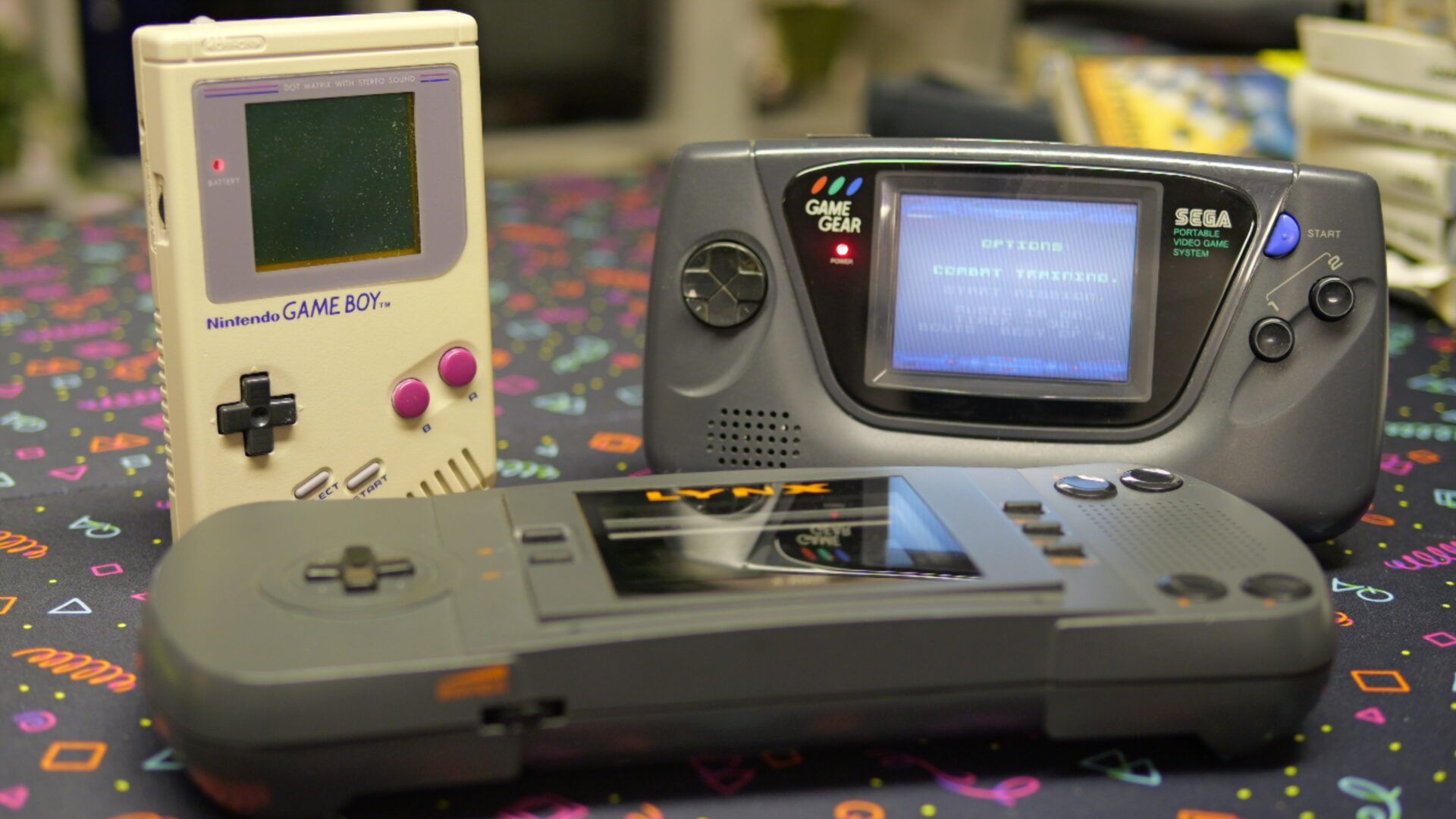
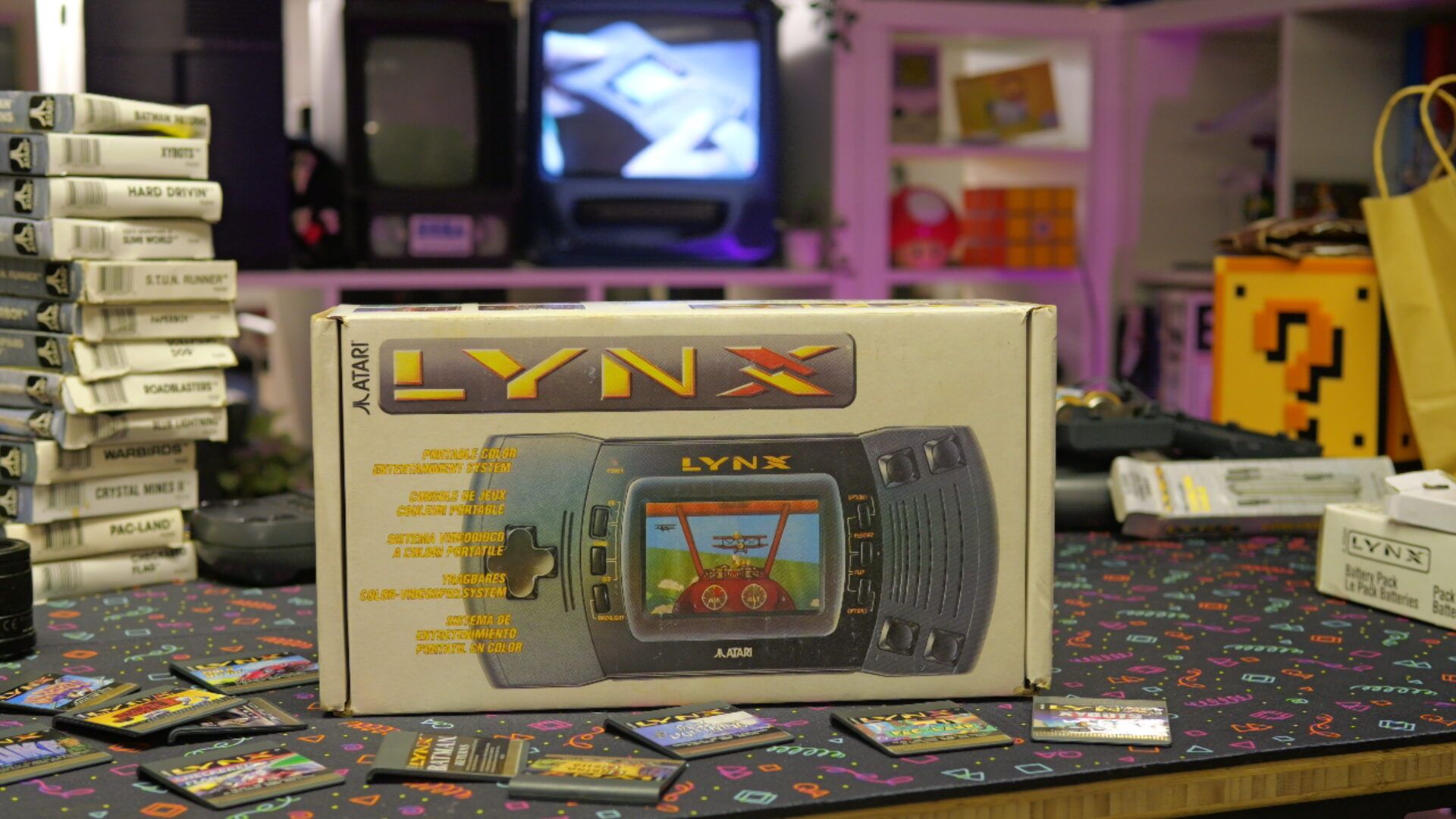
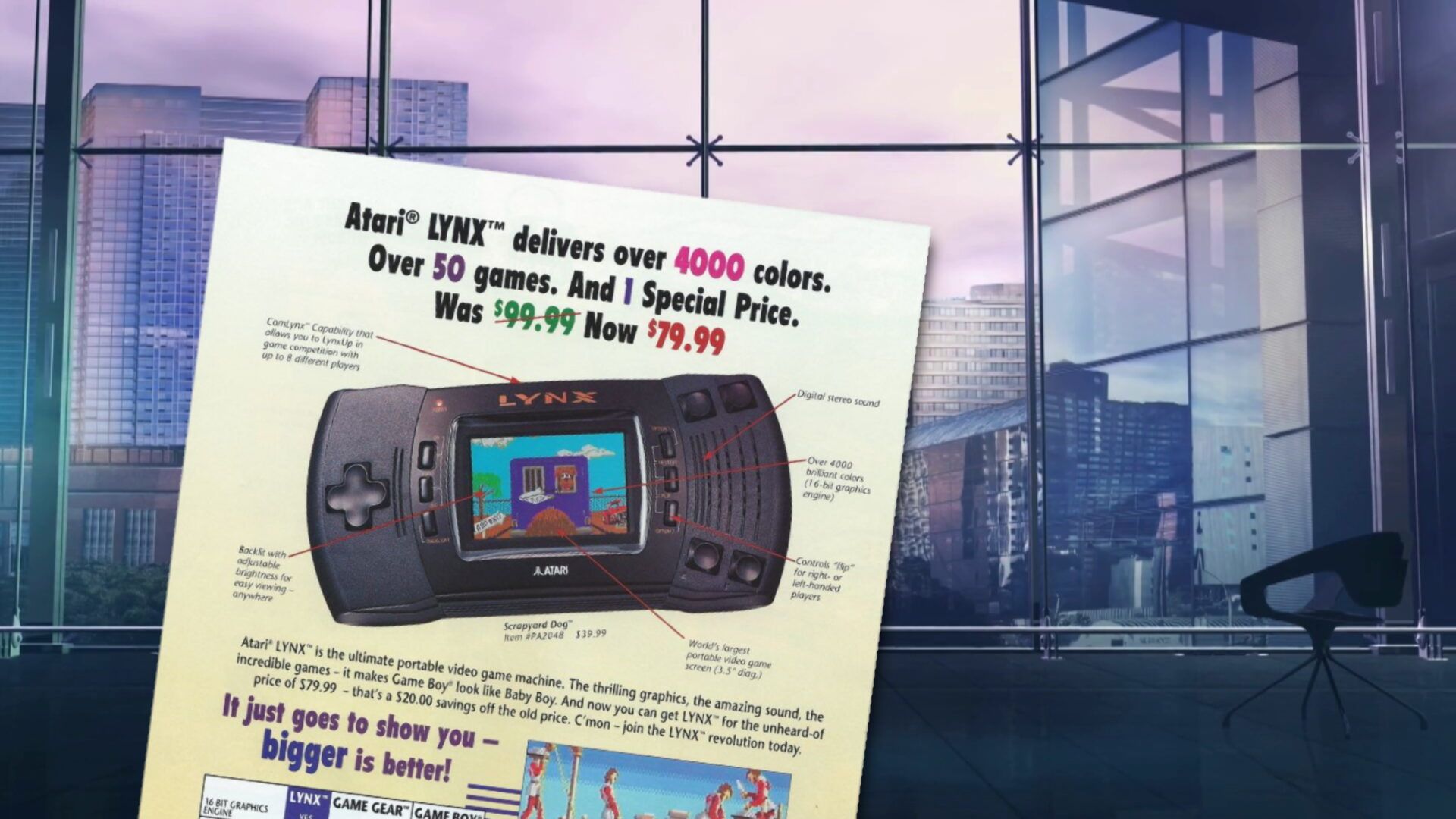
I think I became aware of the Atari Lynx when I was about 8 years old, and instantly I knew it was the future. The Game Boy looked absolutely pitiful in comparison. Even the Game Gear did. This was a handheld, seemingly with the power of a 16-bit console and surely there was no stopping it.
But time told a different tale. Nintendo’s Game Boy soldered on, whilst Atari’s Lynx became a distant memory, and for the life of me, I couldn’t understand why.
Welcome then, to the Atari Lynx Story, where we’ll unravel exactly what happened.
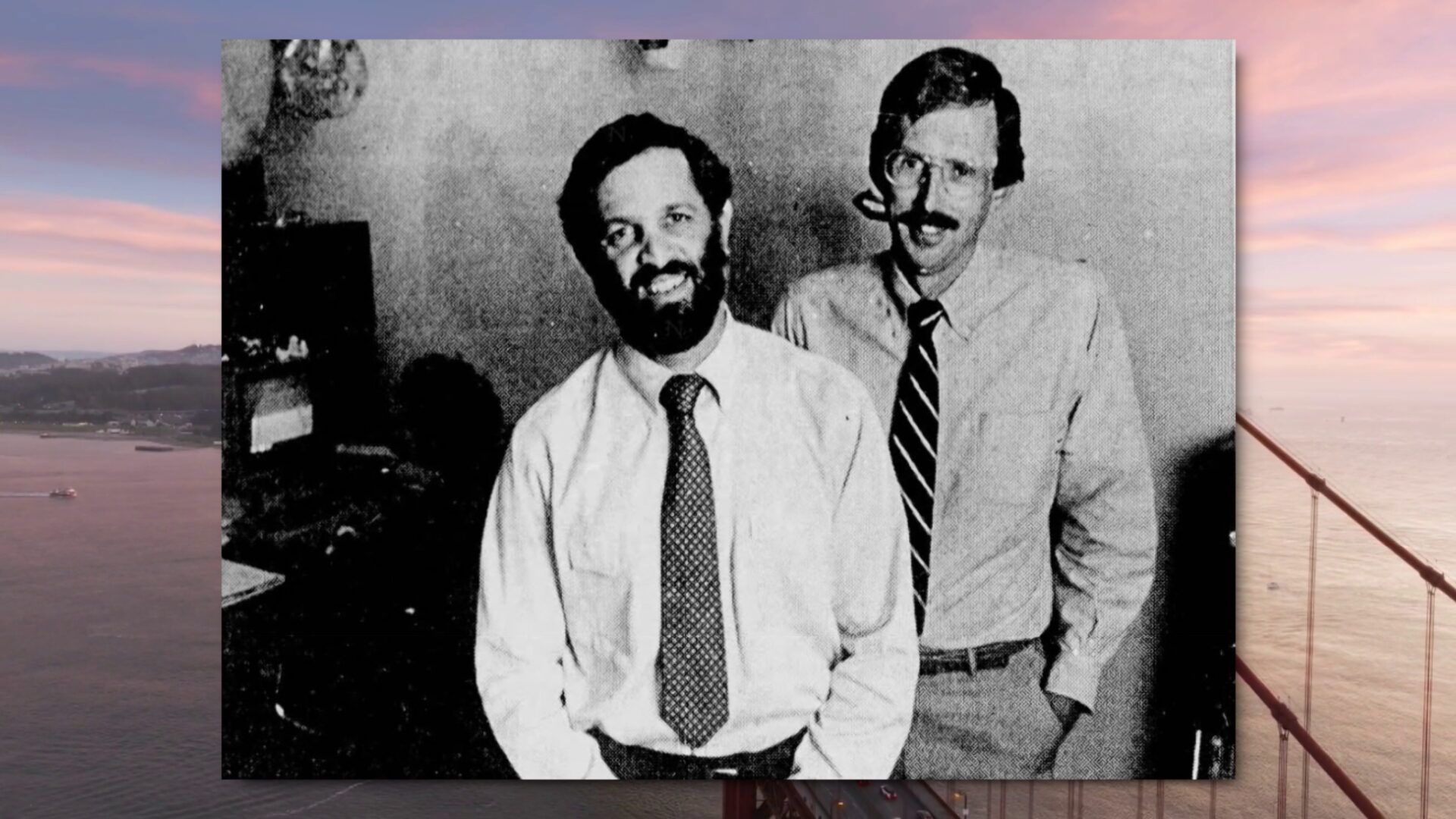
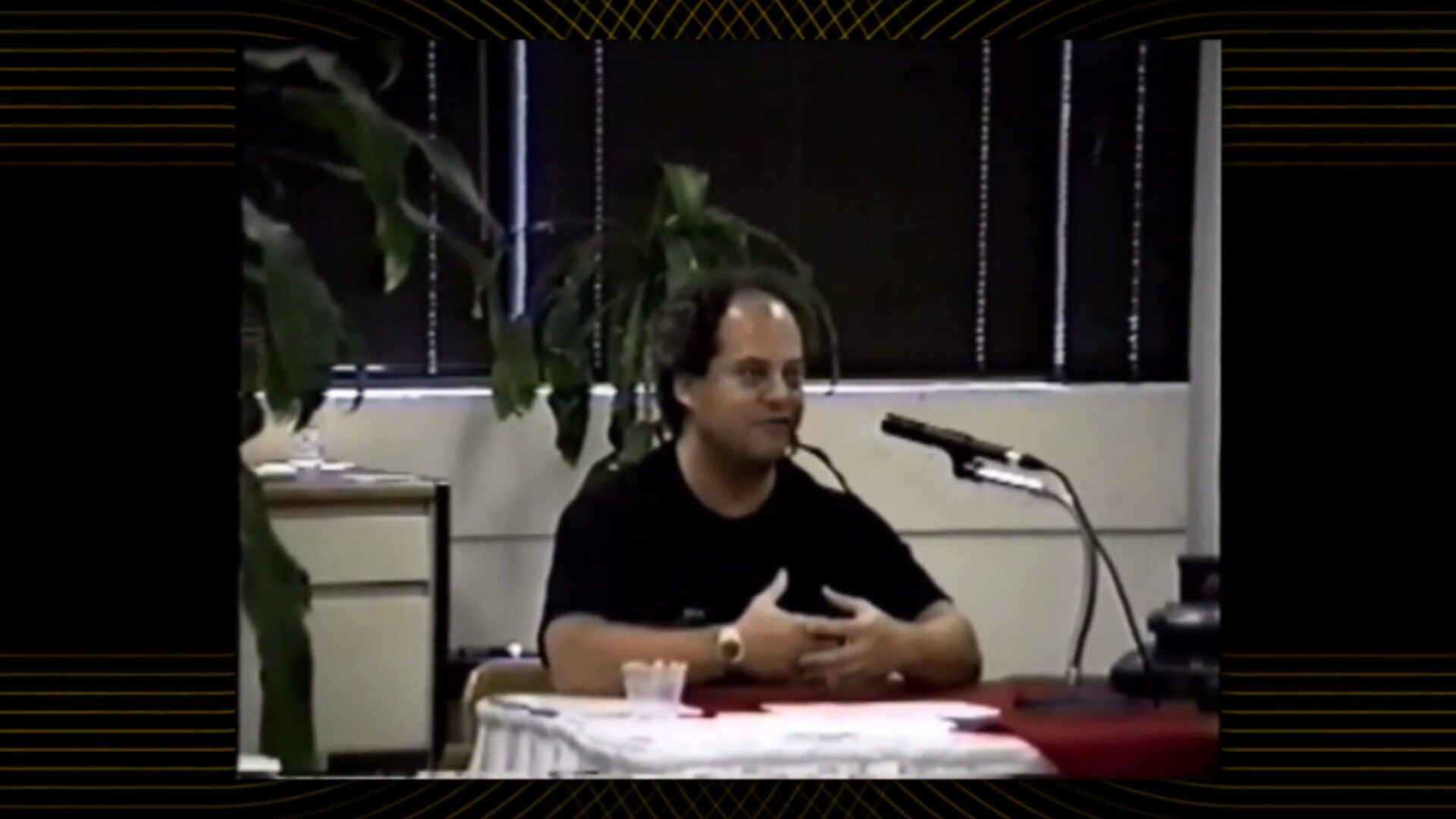
Like so many of these stories, we’re starting at Amiga Inc. Before it was purchased by Commodore. Hi-Toro Inc was co-founded in 1982 by David Shannon Morse, later becoming Amiga Inc. and leading to the Commodore Amiga 1000 in 1985. However, Morse would take a job at Epyx, finding himself on the board of directors from January 1987 onwards. Epyx Computer Software; a game developer founded in 1978 and operating out of San Francisco had started on the Commodore PET they quickly expanded to other systems. In 1987 Gilbert Freeman was the President of Epyx, and he’d been keenly watching the Amiga grow from what started as a shoestring operation, into a swerve away from Atari and finally into the Commodore system it now was. Freeman was so impressed by Morse that he was quickly promoted to CEO in May 1987.1
Gilbert Freeman and David Morse
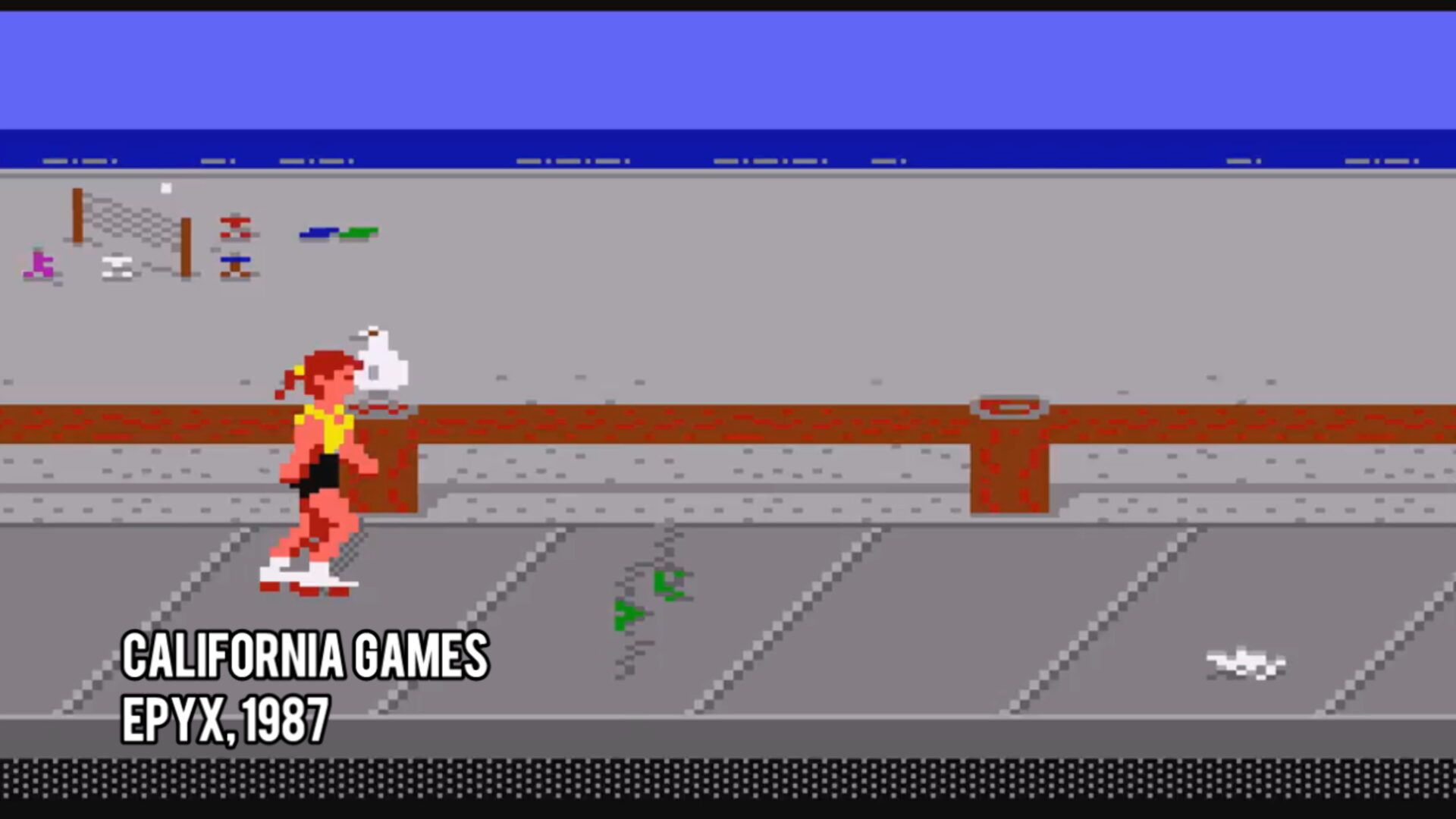
This was the same month that Epyx held their California Games Cookout. Having already had success with Summer Games, Winter Games and World Games, they were looking to capture a vibe, a vibe that was prevalent at the time, and what better way than to release California Games. The Cookout was a celebration of this, hosted near Epyx’s offices and came complete with a full scale BBQ, beachwear, Frisbees, Hacky Sack, a professional BMX freestyler and a pro-Skateboarder.
California Games on the Commodore 64
Epyx were at the height of their powers, but they were now looking beyond their Commodore 64 success and onto their own system. This is one of the reasons why Morse was promoted to CEO. He had pitched the idea of a handheld console to Freeman, which in turn had been pitched to Morse by his son. Freeman was utterly sold by the idea.1
Creating “The Handy”
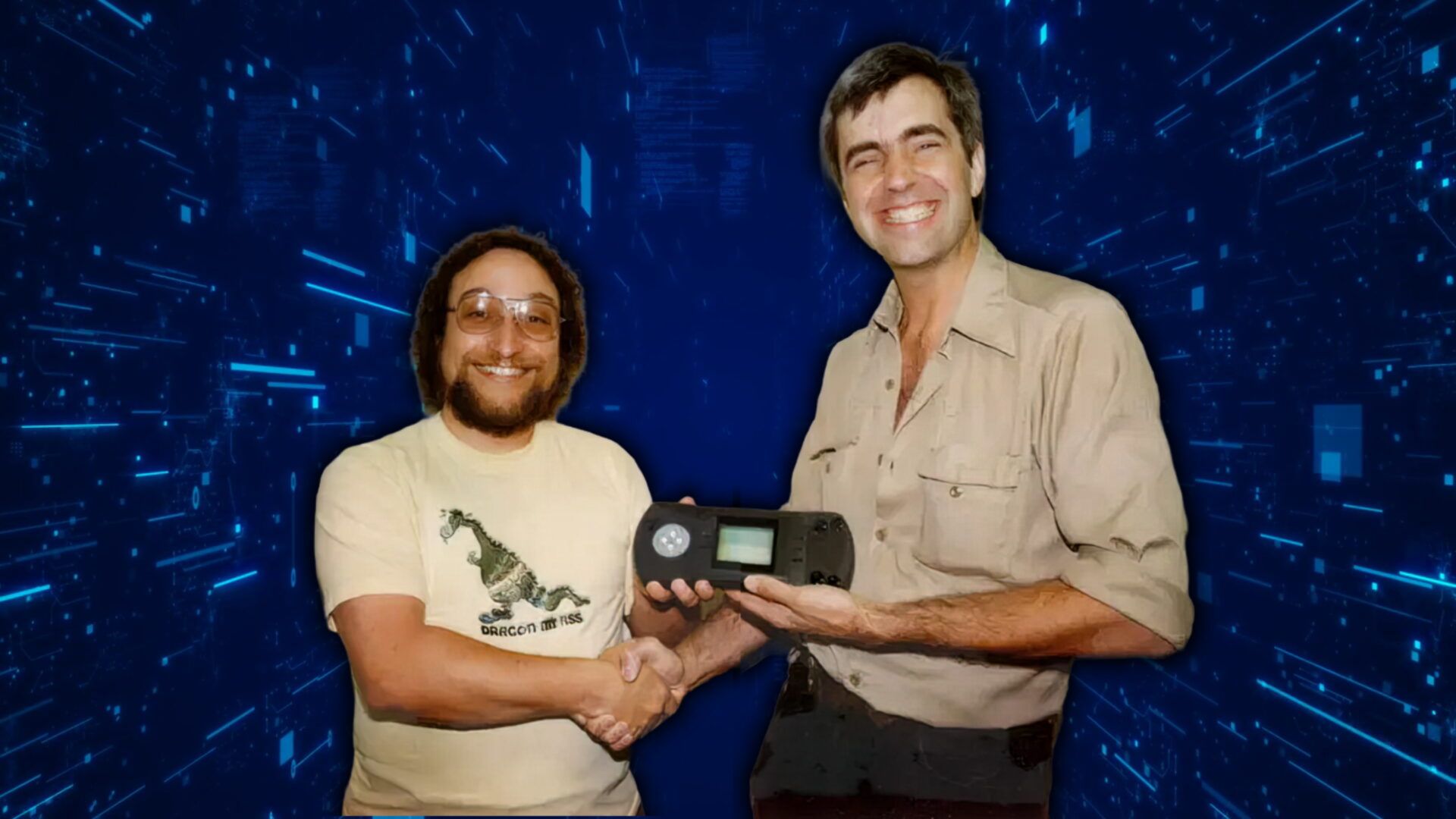
From his Amiga days, Morse already knew exactly who he needed to recruit to flesh out this idea, and arranged a lunch with RJ Mical and Dave Needle, two ex-Amiga employees, famous for working on the Amiga. RJ Mical was a software guy who built the Amiga Intuition UI, and Needle, hardware, who was instrumental, alongside Jay Miner, in completing the Amiga’s Agnus, Denise and Paula chips.
Dave Needle and RJ Mical with a Handy prototype
In a 1989 copy of Electronic Games Magazine2 , Needle is quoted as saying;
“In August of 1987, R.J. and I went out to lunch with Dave Morse. We all went down to this little cafe, near R.J.’s place, that sits on the side of a lagoon. The scenery was beautiful, the weather was perfect, and half-naked women were all around us. In case you haven’t been here, that is the California version of paradise. So during the course of this great meal, we talked about developing an incredible new gaming system. It would be totally portable and unlike anything currently on the market.”
Mical adds;
“Then I asked the question of the hour: Who’s gonna pay for lunch? Morse said ‘I’ll pick up the tab if you design Handy for me.’ We agreed to his terms and that was that. So both of us rushed home, packed our bags, moved into the office, and here we are today!”
This then was the start of “The Handy”; Epyx’s codename for their new handheld console. During this lunch two concepts were actually drafted on literal napkins. “The Handy” and what would later become The 3DO.3
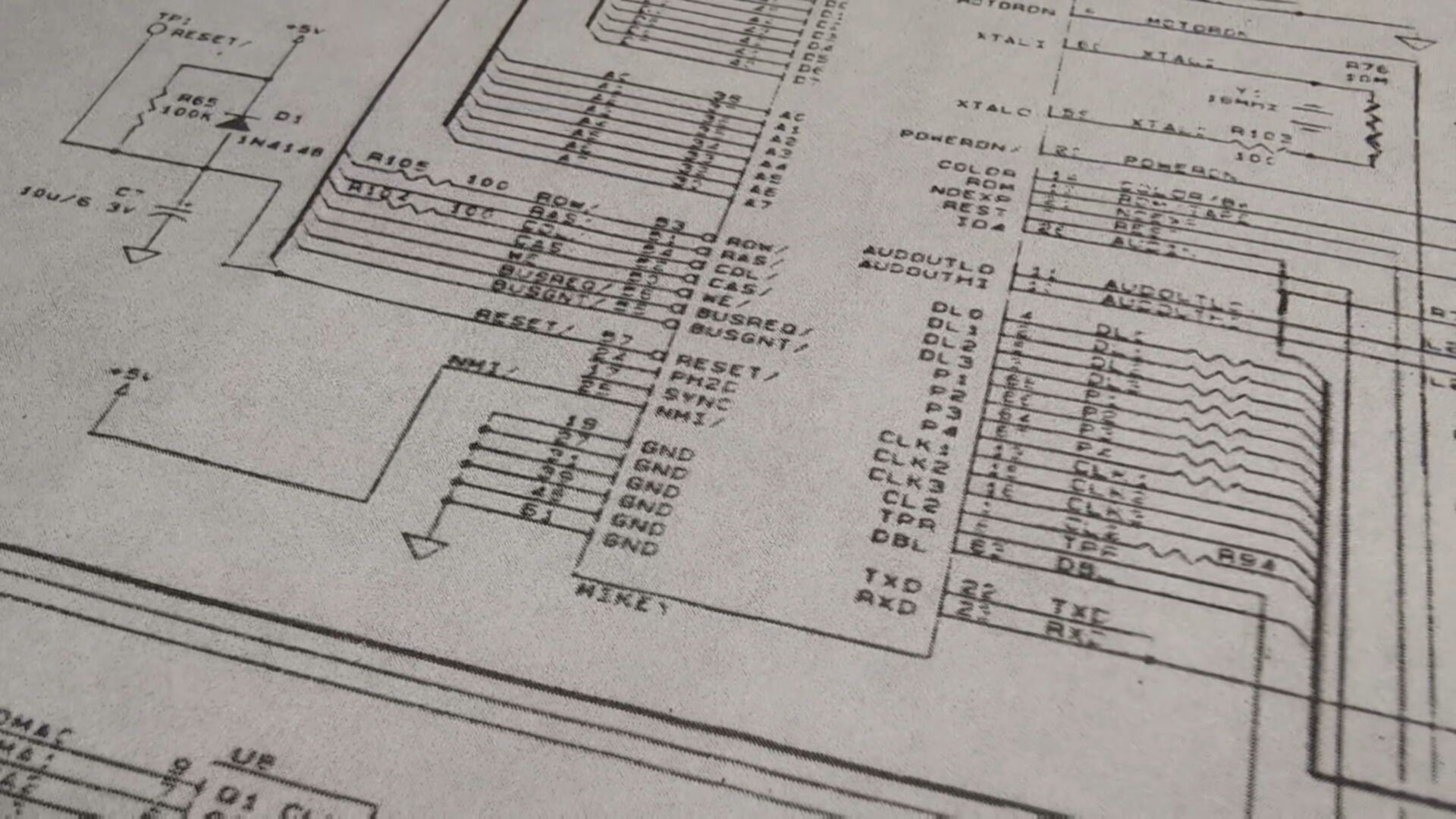
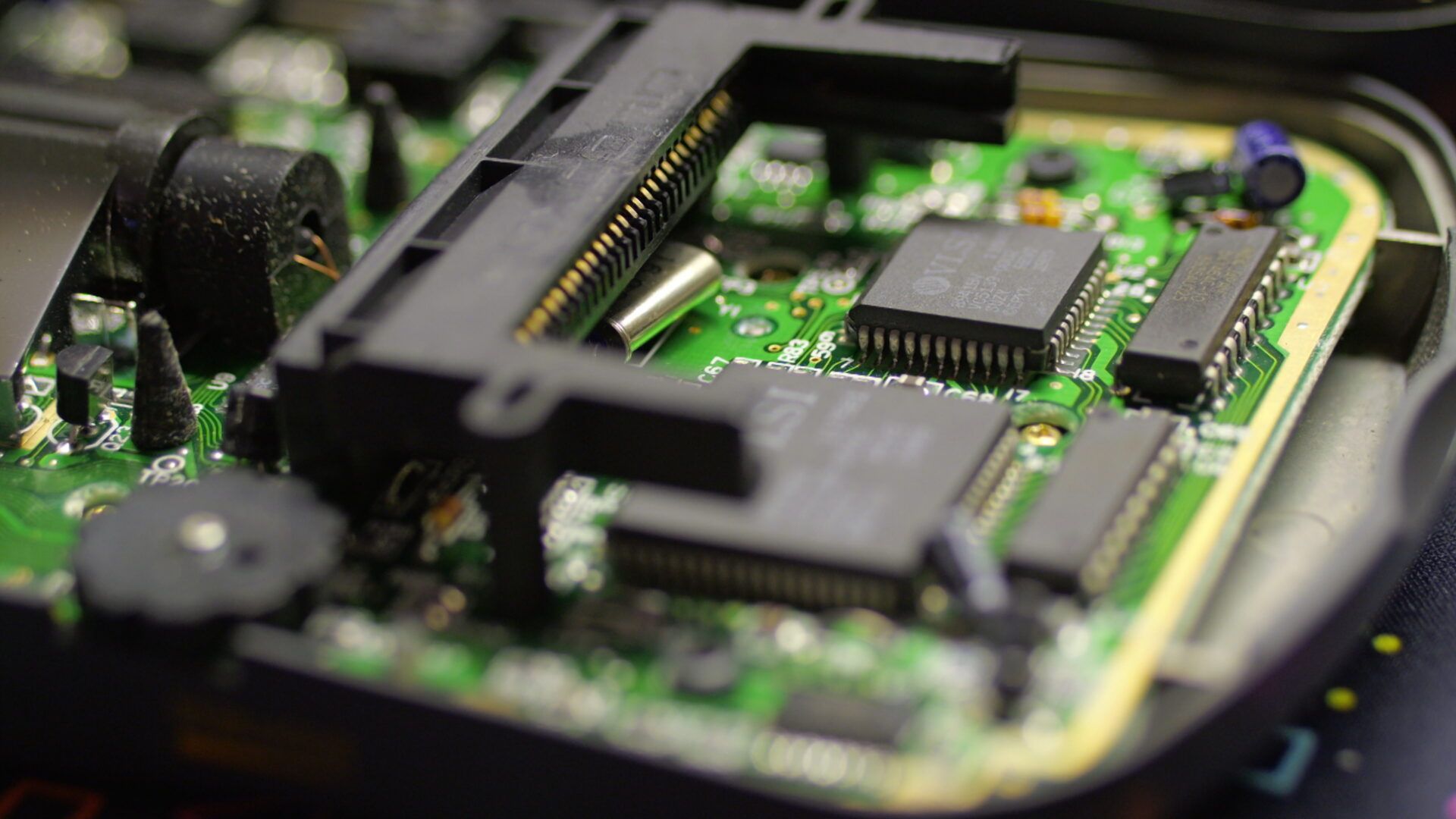
Needle quickly got to work on the chipset, and namely two custom chips that he named Suzy and Mikey, sticking to his traditions from the Amiga.4
Mikey custom CMOS schematic
Mikey was a 16-bit custom CMOS clocked at 16MHz.
It housed an enhanced 6502 CPU running at up to 4MHz, a 4 channel sound processor with an 8-bit DAC and the ability to play PSG style pulse and noise.
System timers, an interrupt controller, 512 bytes of bootstrap and game-card loading ROM and a Video DMA driver capable of using a 12-bit 4096 palette, with up to 16 simultaneous colours.
Suzy, also a 16-bit custom CMOS clocked at 16MHz, but incorporating a Blitter graphics engine, hardware sprite drawing with scaling distortion and tilting. Hardware decoding of compressed sprite data. Unlimited high speed-sprites with hardware collision detection. Hardware clipping and multi directional scrolling and a maths co-processor.
This would have been incredibly impressive for a home console, let alone a handheld, which can be summarised with one quote;
“Our sprite engine (that creates the graphics for the Lynx) is easily 20-30 times more powerful than the Amiga sprite engine.” ~ RJ Mical5
But their choices were also appropriate and measured.
“R.J. and I developed a sophisticated silicon engine that rapidly updated graphics on the screen, generated incredible 4 channel sound, and did all kinds of incredible stuff. So we had the engine, but needed something to drive it. So we picked what was clearly the highest performing CPU (Central Processing Unit) in a certain size and price range. And that was the 65CO2.” ~Dave Needle, EGM #4
Mikey and Suzy
This then was a machine that was incredibly powerful, but also cost efficient. It also meant that less RAM was needed, 1KB of 6502 code would typically equate to 3K of code on a 68000, and most of that precious 64KB memory was needed to copy the cartridge ROM to RAM before use.
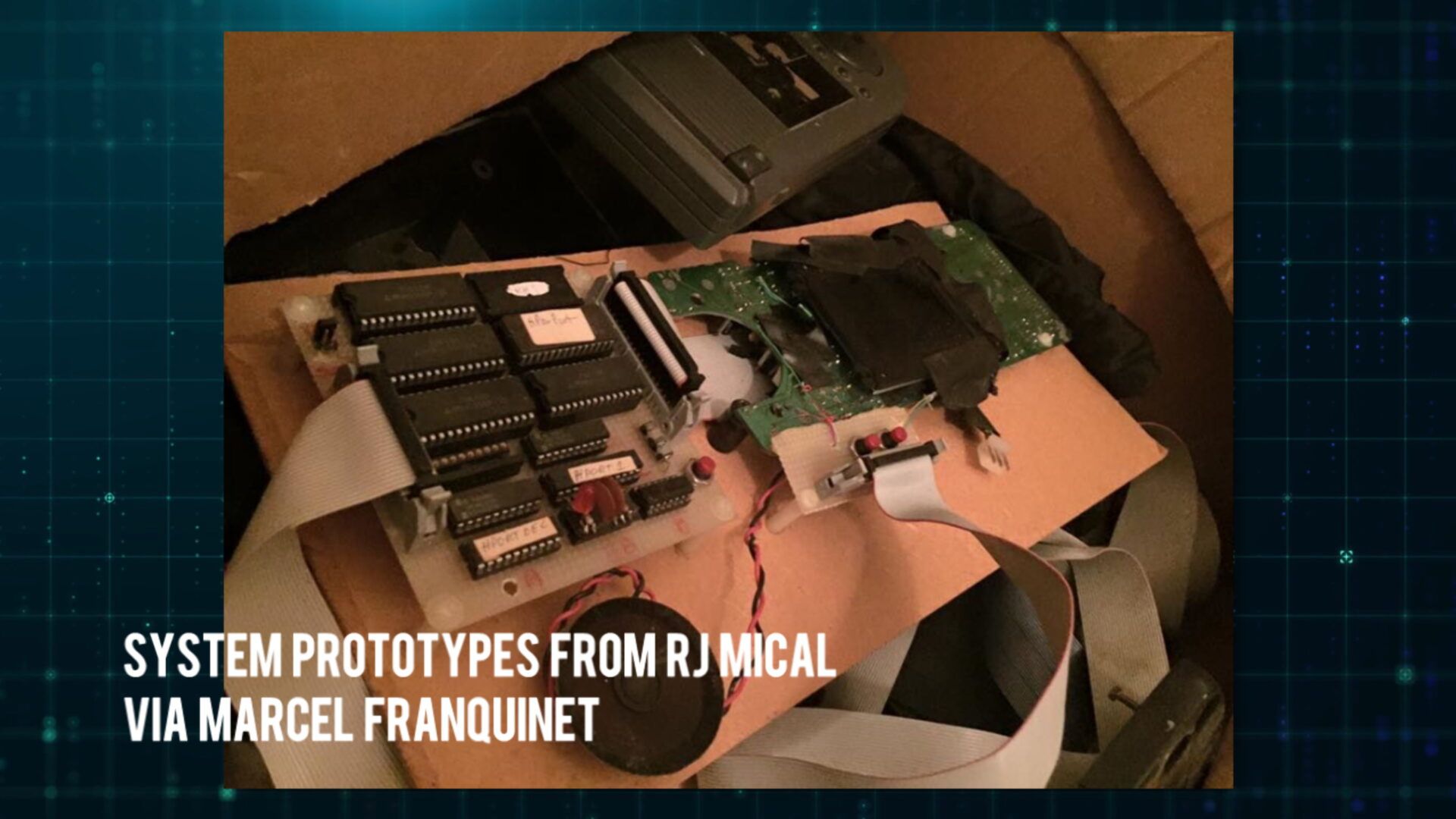
Initial prototypes were built on 4×4 sheets of plywood, covered in chips simulating what the final hardware would do.6 They even spec’d out features like accelerometer controls, which seems crazy on a 1980s piece of gaming tech.
RJ Mical’s Lynx board prototypes via Marcel Franquinet
Given the speed at which The Handy needed to be ready, design was done at a lightning pace, but the team quickly found that the screen would be one of the biggest hurdles.
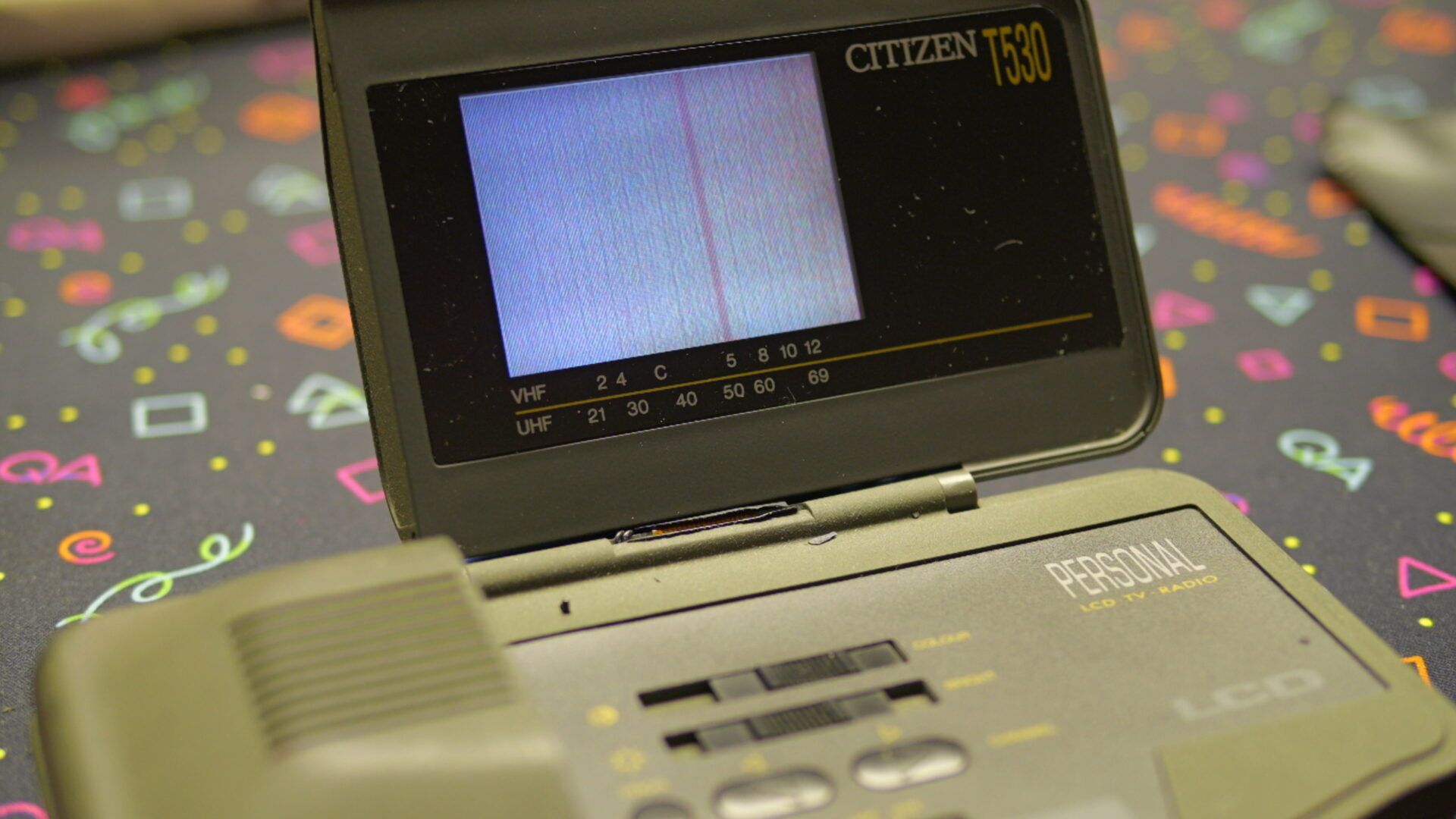
Thankfully The Japanese company Citizen had been creating handheld colour televisions since around 1984.7 These early panels used screen sizes around 2 inches, but luckily they had been working on a newer, larger generation. So when the Epyx guys sparked up a conversation, Citizen had a panel that was the perfect size, and even better yet, they hadn’t actually designed the handheld television for it to fit into. Purchasing the technology the Epyx team got to work on integrating the screen.8
A Citizen T530 Handheld Television
“We actually settled on using 4,096 colors because the LCD glass has limitations in its drivers. Dave and I thought about adding more hues to the palette, but that simply wasn’t possible.” ~ RJ Mical, EGM#4
But they also had to make the screen viewable. Citizen’s screen was passive, and required backlighting.
“Like with the backlight ; we knew it was a critical feature because we wanted the biggest and brightest display we could. The reality was that the technology we looked at was so expensive. There were viewing angle problems and hotspots from the light, all kinds of things. Then the magical day came when a guy found the answer and we realised we could have a gorgeous display!” ~RJ Mical, Retro Gamer#1299
Using a Cold Cathode Fluroescent, combined with diffusers, reflectors and waveguides, they managed to get a colourful and usable image on screen.
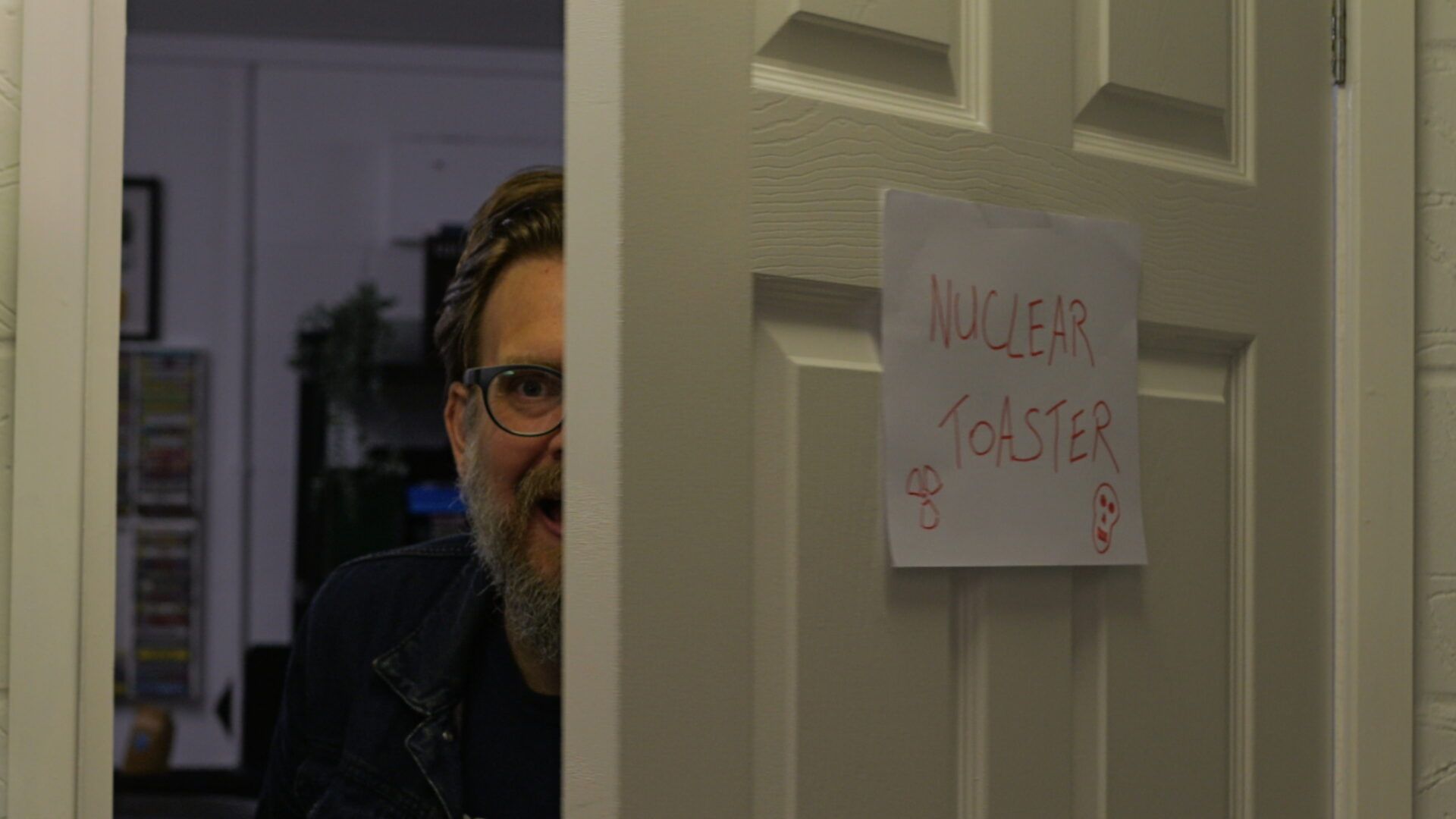
They now had a viable unit, a unit that was dubbed “The Potato” due to it’s size and shape, and work continued in a development area called “The Nuclear Toaster” that was top secret, even for most of the employees within Epyx.10
Probably best to stay out of the Nuclear Toaster tbh
So then, just like with the Amiga days, where a revolutionary computer had been funded partly by selling joysticks and gaming peripherals, time was repeating itself at Epyx. But also like Amiga, cash flow issues were rearing their head behind the scenes and something would soon have to give.
Too Many Projects
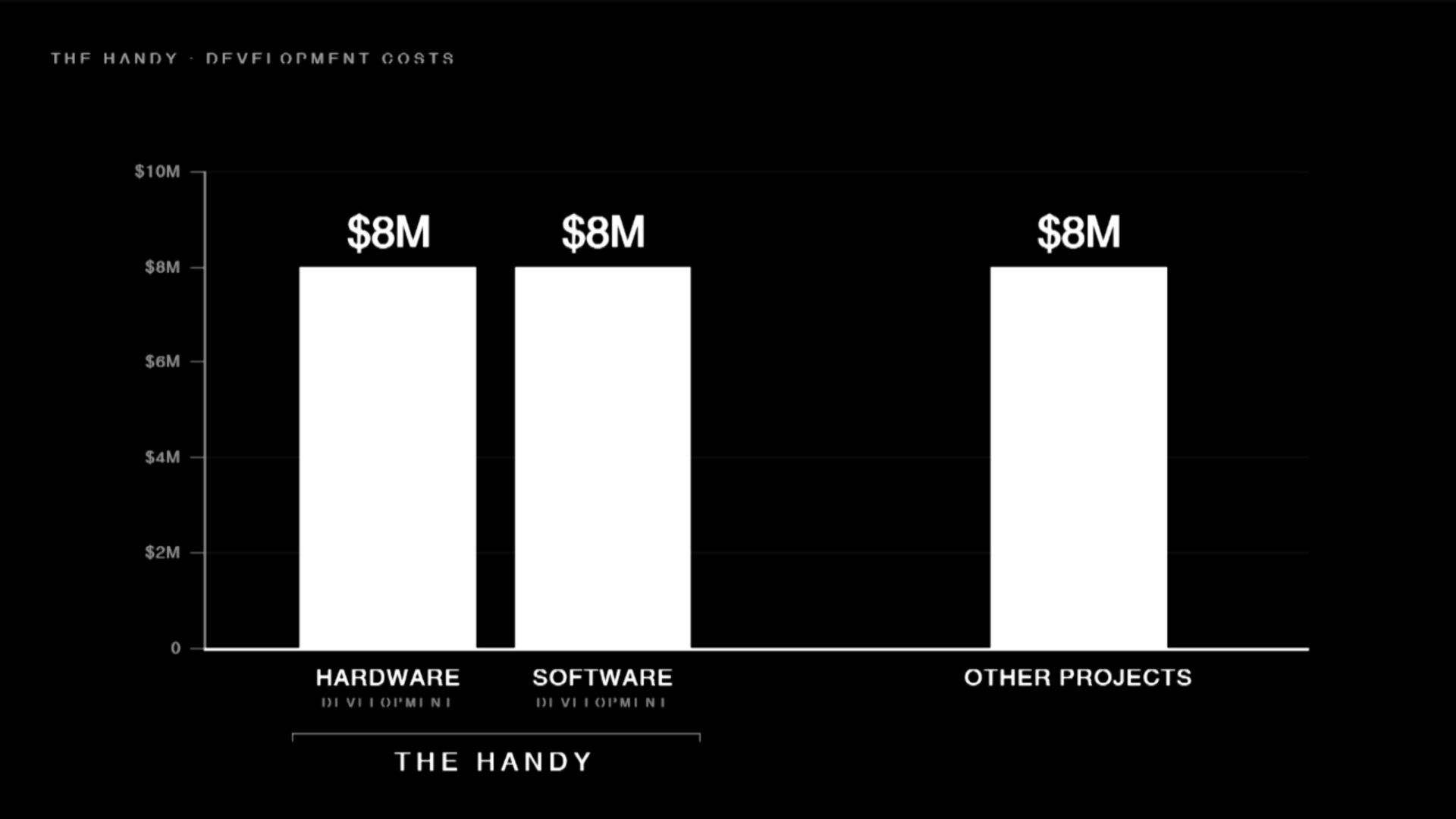
During the California Games cookout, Epyx weren’t just toasting to their games success, they were toasting to their revenue success. That year, they had achieved $27 million in revenue, but the problem was that half of their sales came from the Commodore 64 and Freeman knew its days were numbered. Morse was brought on to steer a new direction, with The Potato being the lead project with estimates of between $4 and $8 million for its hardware development alone, not even bringing software into account, which could easily double it.11 Had they focussed on that alone, they might have stumbled on through, but they didn’t.
Epyx spread themselves too thin at a time when cashflow was imperative
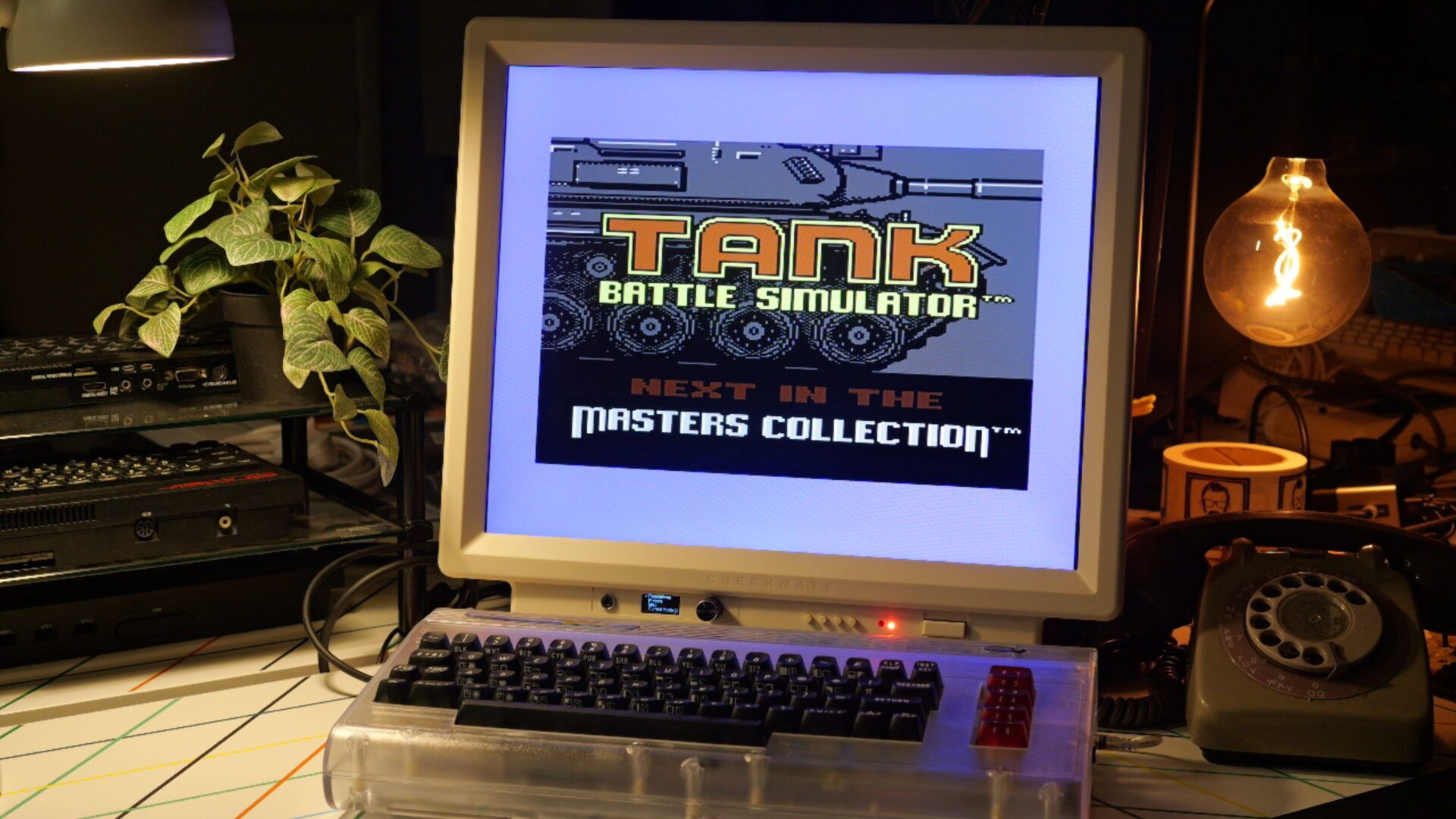
They also kicked off a line called “The Masters Collection”, straying from their previous success into RPGs and submarine sims. They delved into creativity software, trying to keep up with Electronic Art’s own range. They also imported European budget action games. All of these came with a cost, but at least they were sticking to software, and the systems they knew back to front.
Tank Battle Simulator – One of Epyx’s Masters Collection
Their decision to invest in VCR-based interactive games really sums up the problematic choices Epyx were now making.
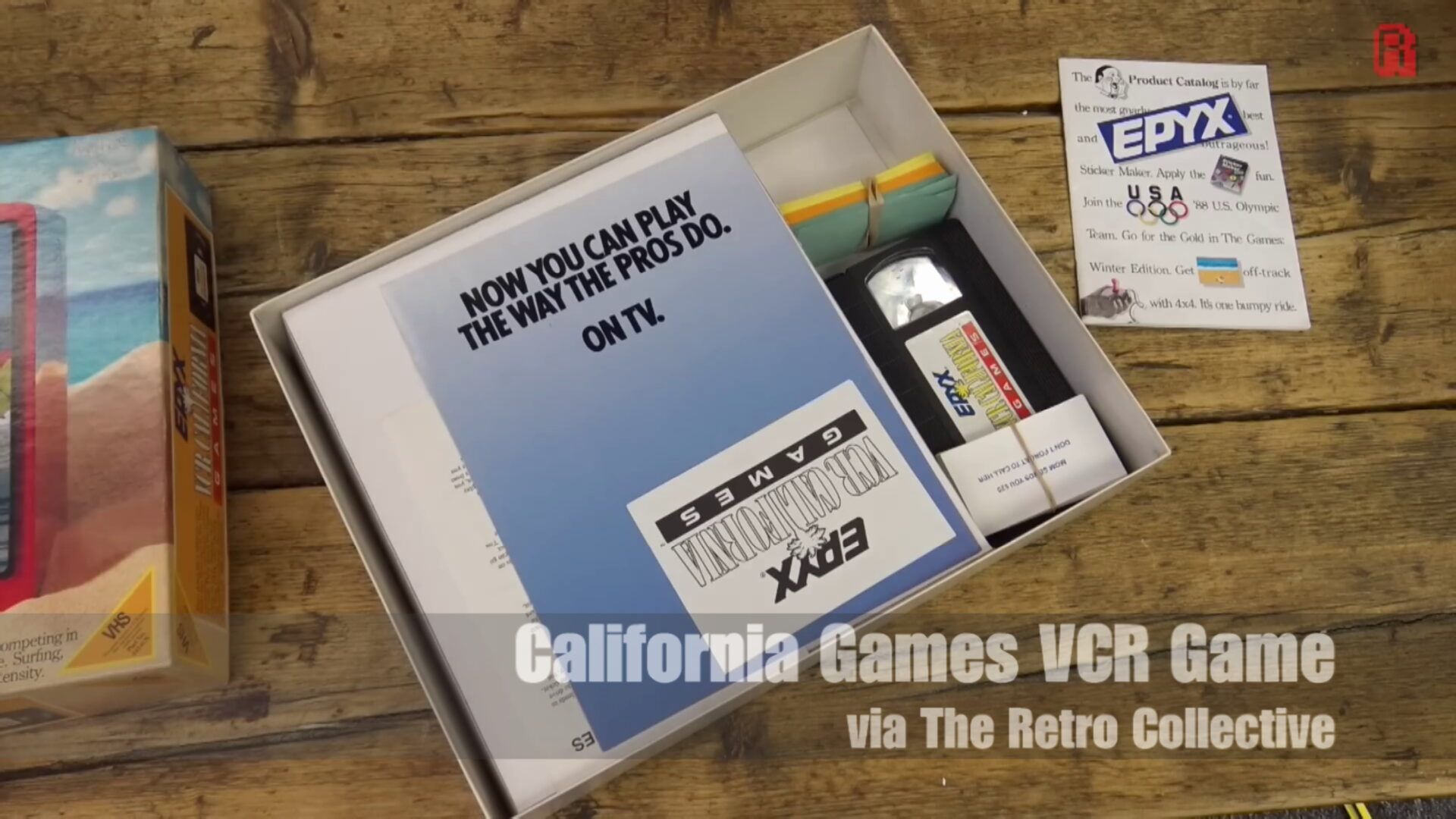
Epyx may not have tried to create a doomed VCR console like others, but they did start producing VCR based board games, including VCR California Games, VCR Top Rank Boxing and VCR Golf.
Here is VCR California Games. It’s got the same box art as the computer game. It’s got the same basic premise. But it’s a board game. Hacky Sack in board game form is not fun, trust me.
VCR California Games (via The Retro Collective)
All these distractions had good intentions. To capture different slices of the market and create an even more secure footing for the growing company. But in reality, it did the exact opposite. Epyx’s total revenue actually climbed from $27 million to $36 million in 1988, but their expenditure was far higher, and that was a problem. A big problem.
The Sell-off
Epyx couldn’t afford to complete The Handy and launch it, so they began looking for someone to fund its development. Their first approach was to Sega. They knew Sega was doing well in Europe and had already had talks about porting California Games over to the Master System.
“We showed it to Sega and hoped they would buy it instead of them doing what became the Game Gear. If they’d bought the Lynx I think that could’ve completely changed everything.” ~RJ Mical, Retro Gamer#129
With Sega declining, the legendary video game designer Henk Rogers offered a hand, having connections with Hiroshi Yamauchi at Nintendo. After setting up a meeting, Dave Needle, Dave Morse and Joe Horowitz would find themselves on a flight to Japan, ready to pitch their idea. However, Yamauchi was reportedly unconvinced by battery life, and the cost of production.12 I’m sure the fact that they were already working on their own handheld was also a very strong factor here, but prior to the trip, Epyx were blissfully unaware.
Having inadvertently now given their future competition the heads up, they started looking for deals closer to home. Now with The Handy in prototype stage.
In January 1989, at the Winter CES in Las Vegas, The Handy was demonstrated to industry insiders, and reportedly received good feedback. This was an NDA protected demo to try and find further suiters.13
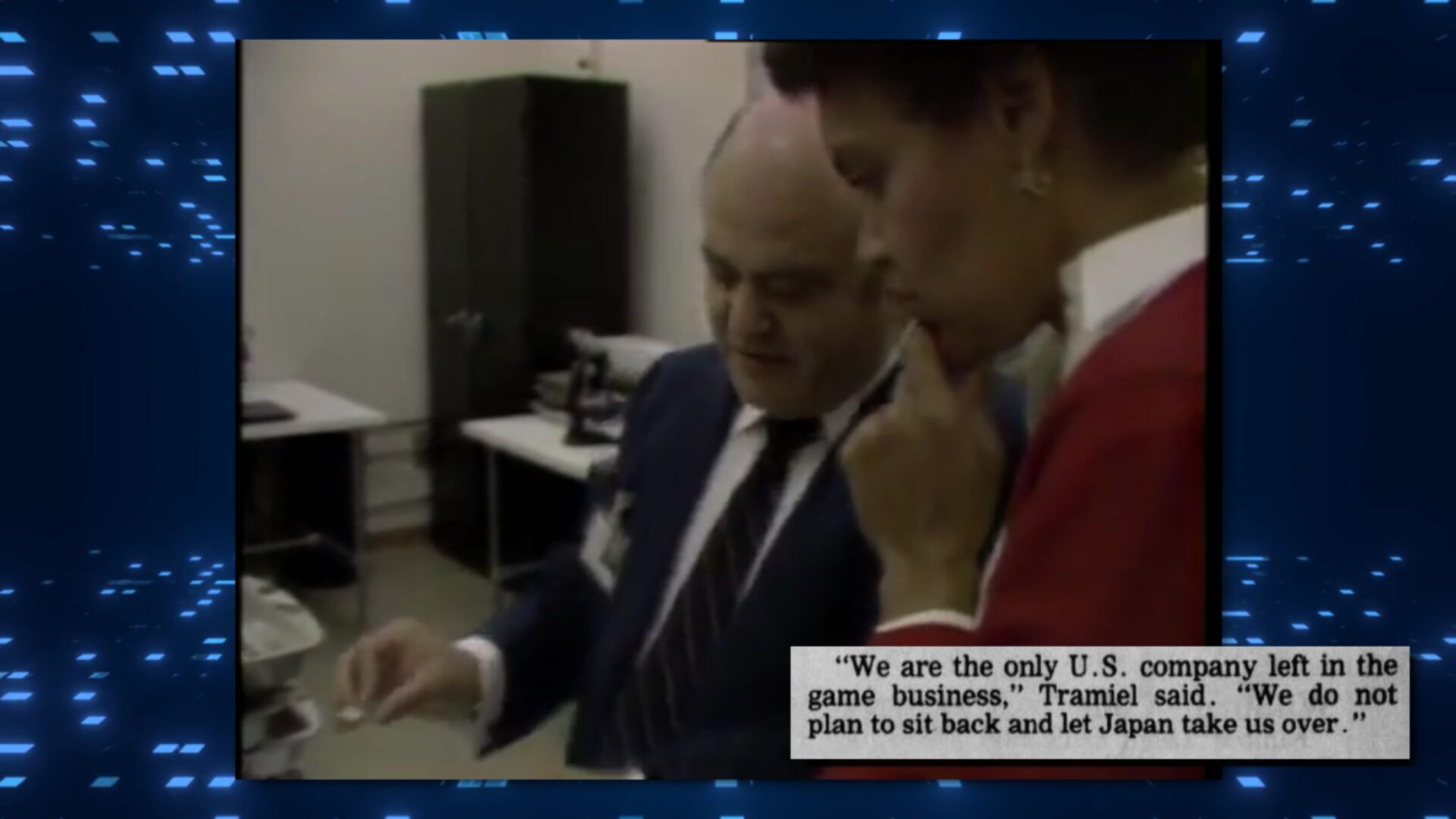
But, the only company who appeared interested in backing the project was Jack Tramiel’s Atari.
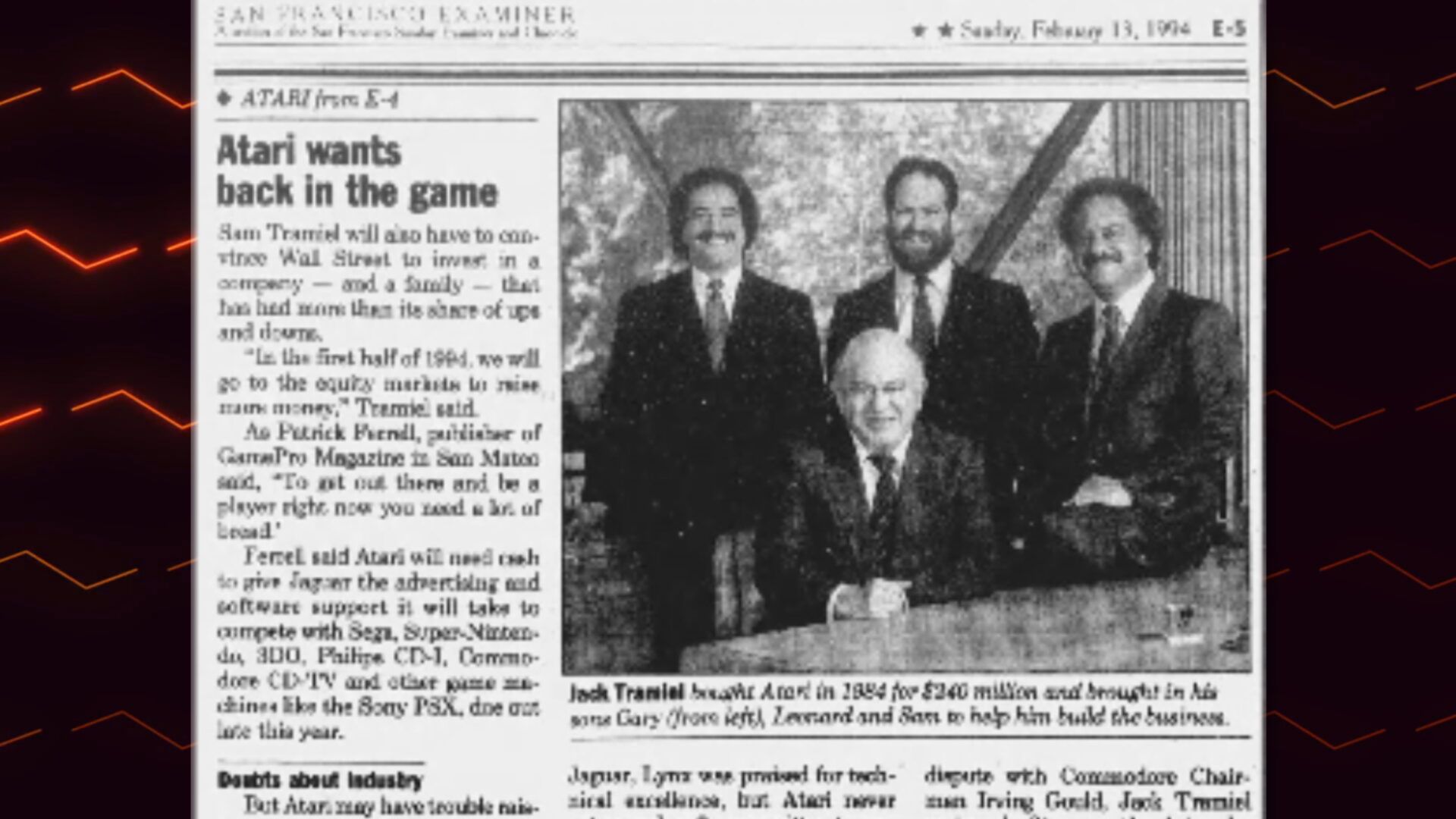
The same Atari that David Morse, Dave Needle and RJ Mical had encountered in their Amiga days, and had taken a little bit of a dislike to. Mainly due to Atari attempting to sue Amiga and seize the Lorraine chipset, after their somewhat underhand deal with Commodore.14 This lawsuit, that wasn’t finalised until 1987, and the way Jack Tramiel had conducted negotiations left a very bitter taste in the ex-Amiga teams mouth, and now, here they were with Jack’s son, Sam Tramiel, now Atari CEO, trying to hammer out an incredibly bitter-sweet deal.
Atari’s Sam Tramiel speaking at the Jaguar launch
And just like Atari’s first deal, it would turn sour, very quickly.
Atari
A year or so prior, Atari had turned down a deal offered by Sega to distribute their new Mega Drive console in America.15 Given the Master System hadn’t been a great success there, they offered pretty lucrative terms to Atari, but Jack Tramiel was completely against it. Maybe because by his own admission he despised Japan taking over the American game market. Maybe in part because Sega were a pretty powerful company, and Jack preferred to prey on the weak… WHO KNOWS. But now perhaps with the inklings of regret starting to show, they were trying to make this new deal work.
Jack Tramiel was never a fan of Japanese technology companies
Inside Epyx, Chuck Sommerville was still working away on software for The Handy and recalls;
“Atari was trying really hard to make things right for us. I was very hopeful that things would turn out well, because Epyx had basically run out of development money, and we had few options left.” ~Sommerville, Retro Gamer#12916
However both RJ Mical and Dave Needle had told Morse that if the deal went ahead, they’d walk.17 Leaving the machine they had built with the dwildling team at Epyx under Atari’s watchful eye.
But with all other options exhausted, this was it.
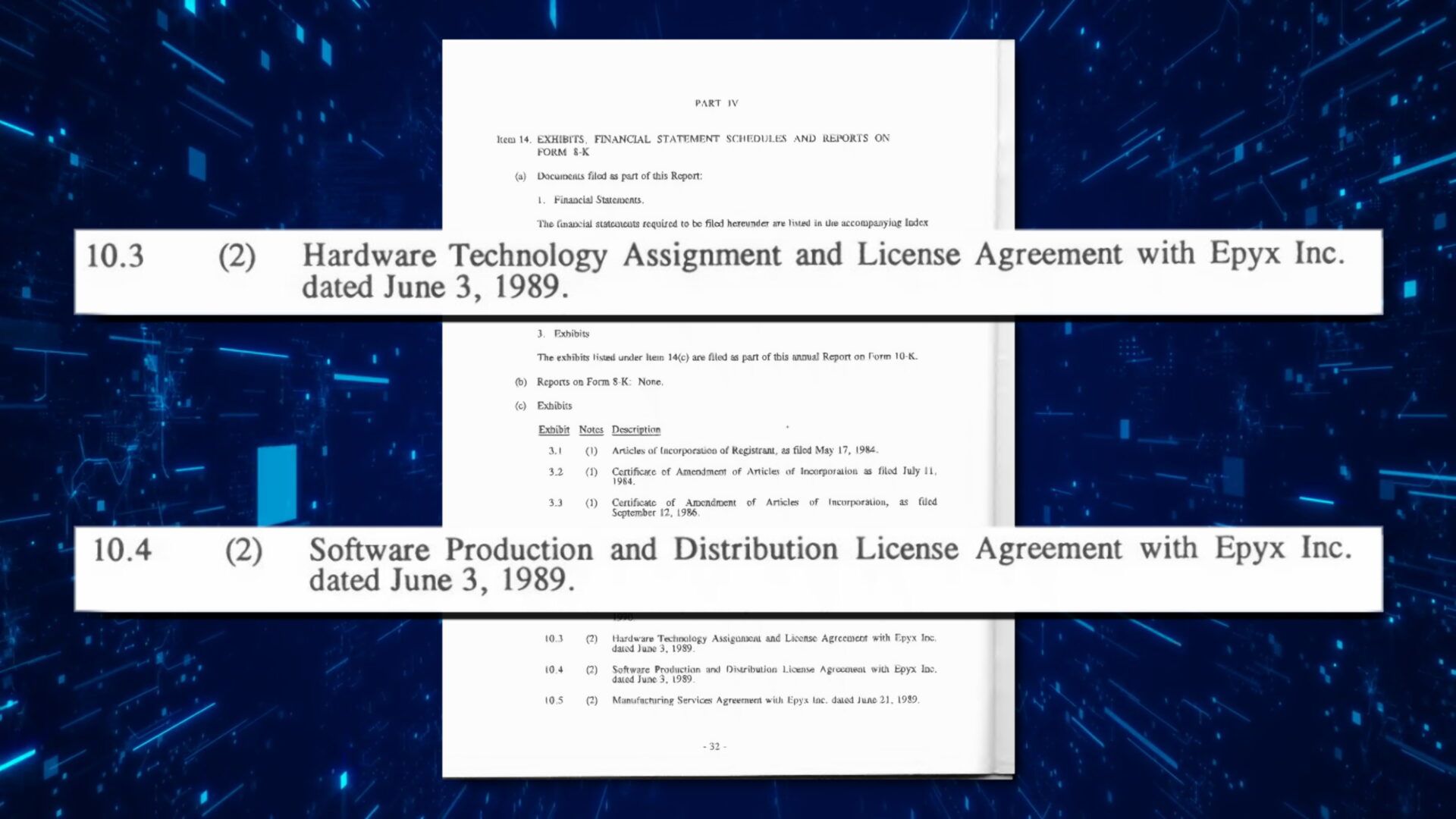
On 3rd June 1989, two initial Atari-Epyx licencing agreements were signed; The Hardware TEchnology Assignment and Licence Agreement AND Software Production and Distribution Licence Agreement.18 But the timing here was extraordinarily tight. This was immediately before the Summer CES in Chicago, where the system made its debut as the “Atari Portable Entertainment System”.
Licence agreements between Epyx and Atari
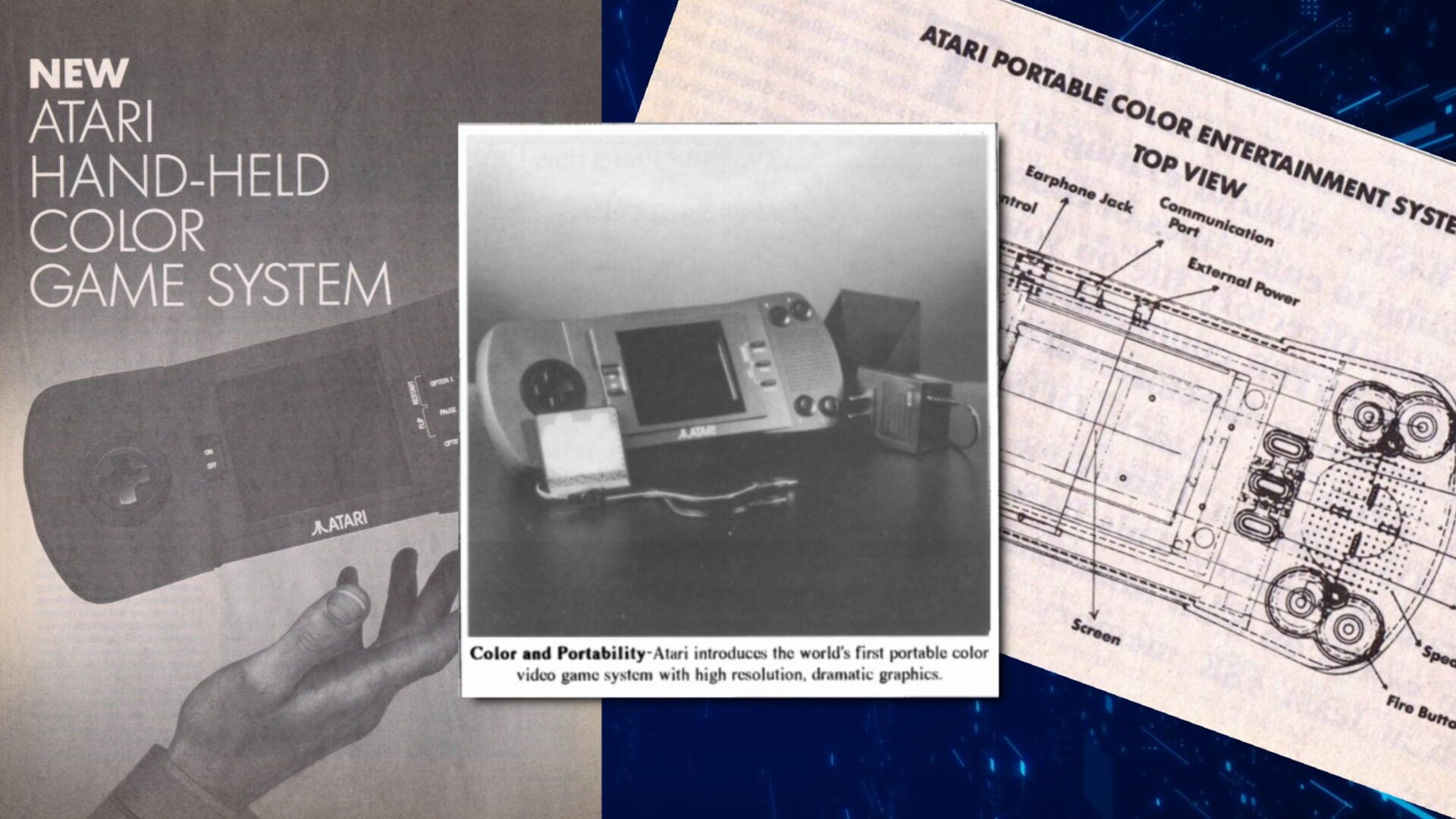
Epyx hadn’t been sleeping throughout the Spring. The system now looked a lot more like the finished product than a potato. Stylistic choices such as the……
3.5″ 160×102 pixel screen, Two sets of fire buttons for right or left hand play, am eight direction thumb pad, NES Style, Volume and brightness dials, a mono headphone out, ComLynx connector, 9V DC in and the whopping 10.5″ x 4.5″ x 1.25″ size…
Initial coverage of the APES (or Atari Portable Color Entertainment System as some reported)
Gave the unmistakable Lynx footprint.
But at this point, Epyx still technically owned the console. Atari were simply licencing it.
On 12th June 1989, The OEM Purchase and Distribution Agreement was signed between the parties. Pinning down the OEM manufacturing arrangements.19
On 21st June The Manufacturing Services Agreement was signed, and various arrangements were put in place between Epyx and Atari.20
Epyx now had to meet various milestones in order for Atari to make payments to them. These payments formed the core part of the licencing deal, but meant that Epyx needed to deliver some key milestones going forward.
The First of those was getting the console delivered and ready for sale for the 1st September 1989, the day on which the Atari Lynx was launched commercially in the US.
*ahem*
The Launch
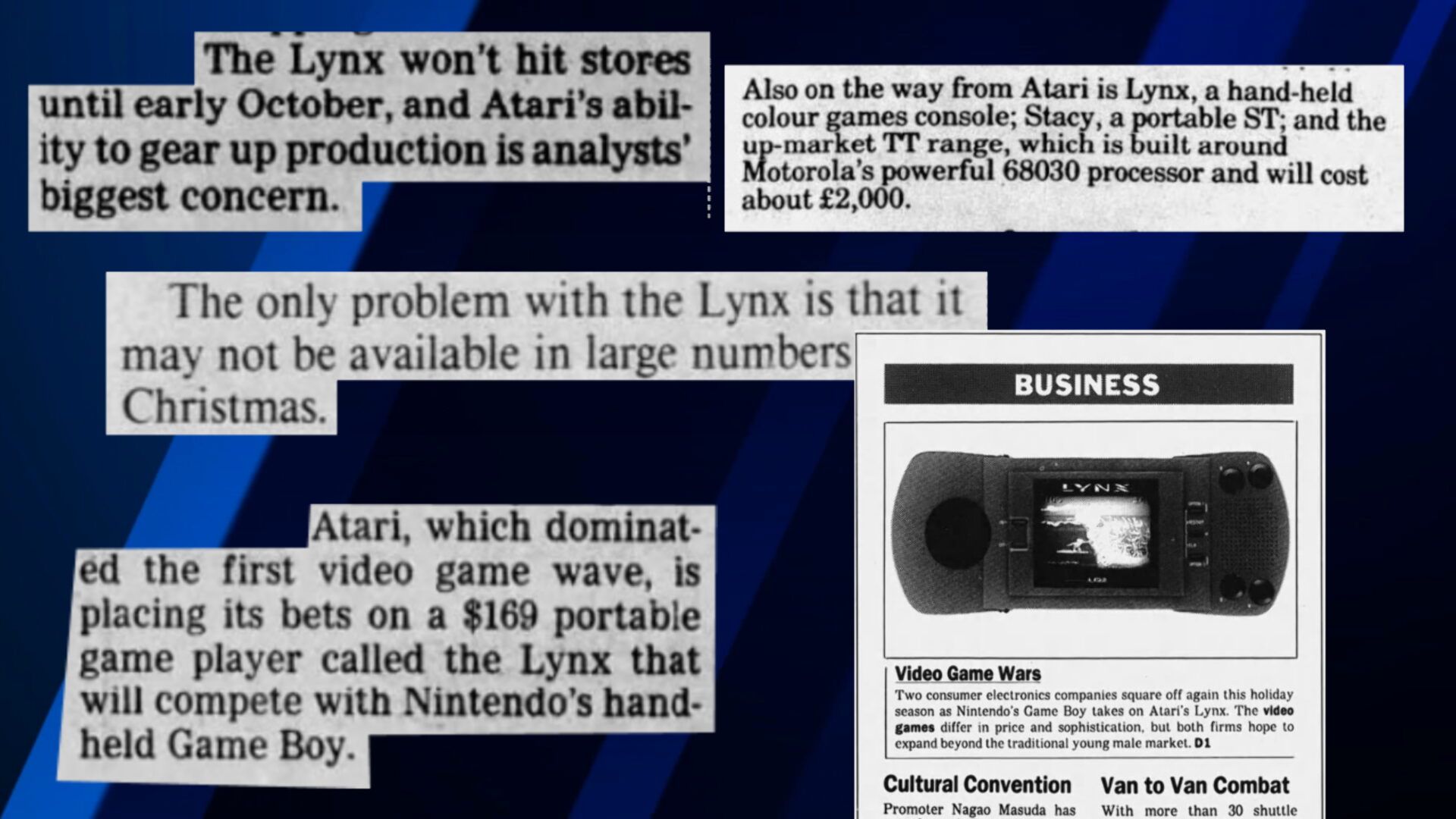
At least, this is what every article on the internet will tell you, and perhaps it was likely the day that Atari wanted to launch their new handheld. But it didn’t happen. In fact news sources throughout September and October still refer to the upcoming Atari Lynx, with speculations on when it will be available.21
Early media coverage of the Atari Lynx
What did happen however, was the console was given it’s new name; The Atari Lynx. Likely due to the fact that the Link cable that shipped with the machine was one of its main selling points.22 Pushing this as not only an incredible handheld 16-bit experience, but also one that you could share with your friends, meaning that they absolutely needed to buy one as well. It’s also the first in Atari’s lineage of naming consoles after big cats, with the unreleased Panther and Jaguar to follow. But let’s get back on track.
The other thing happening at this time was that Epyx were struggling. Really struggling.
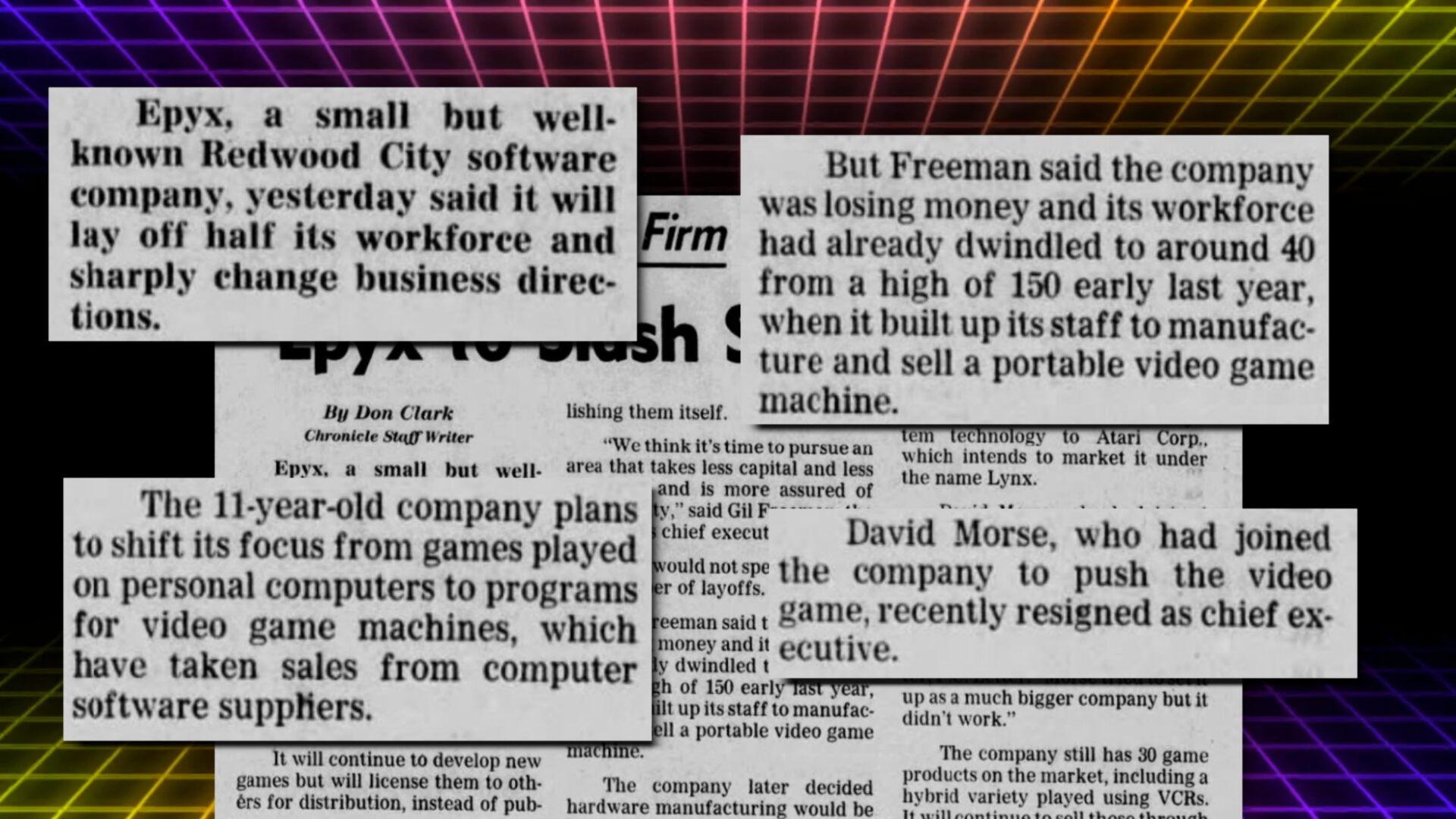
On 15th September 1989, Epyx announced that it would lay off half its staff, with numbers already having dwindled to 40 from 150 just a year prior.23 This formed part of a new strategy shift from games on computers to games on consoles. The Nintendo Entertainment System had already taken a big chunk of their audience away, however, unwilling to commit to Nintendo’s licencing deal, Epyx had shied away from that console and missed the boat. All their remaining energy now was being poured into The Atari Lynx.
Epyx were struggling to stay afloat even with Atari’s deal
What’s more David Morse had resigned as Chief Executive leaving the company in a perilous position.23
By November, the Atari Lynx was being promoted, it was being talked about, but Atari still hadn’t managed to get stock on shelves. They were now promising that units would be available no later than 18th November.24
And this time, they actually delivered. Well, almost.
Japan First
The initial launch was actually in Japan, facilitated by Atari Japan. This is where the units had originally been manufactured before Tramiel pulled manufacture back to the US during September, along with most of the stock, numbering some half a million units. According to Richard Hilton, communications head between Japan and USA, Japan were left with a fraction of this stock.25
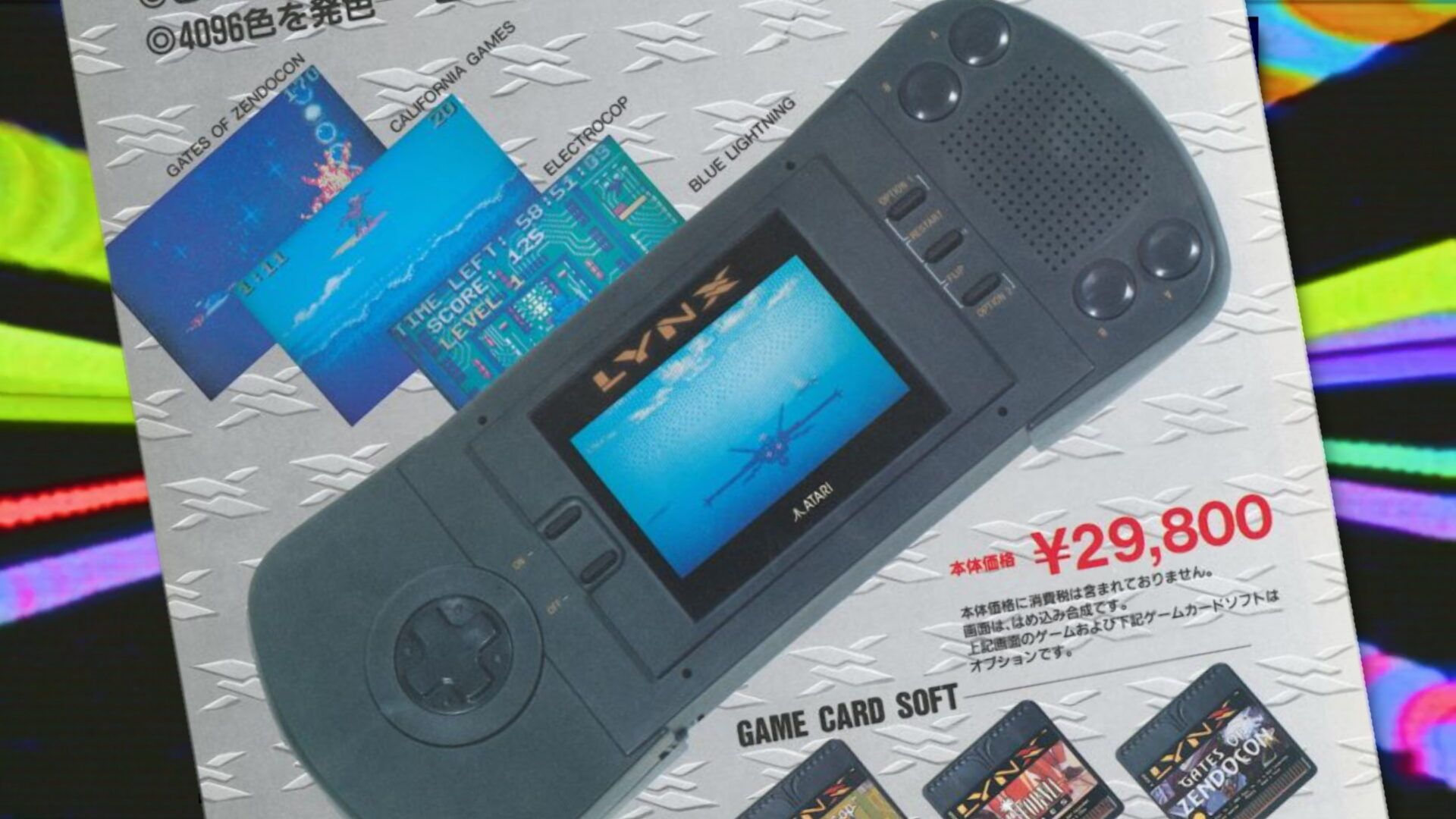
Early Japanese Lynx advert
Like The USA, the official announcement had been in September. September 6th, but the handheld wasn’t launched until 20th November, and available in only 20 retailers split between Tokyo and Yokohama.26
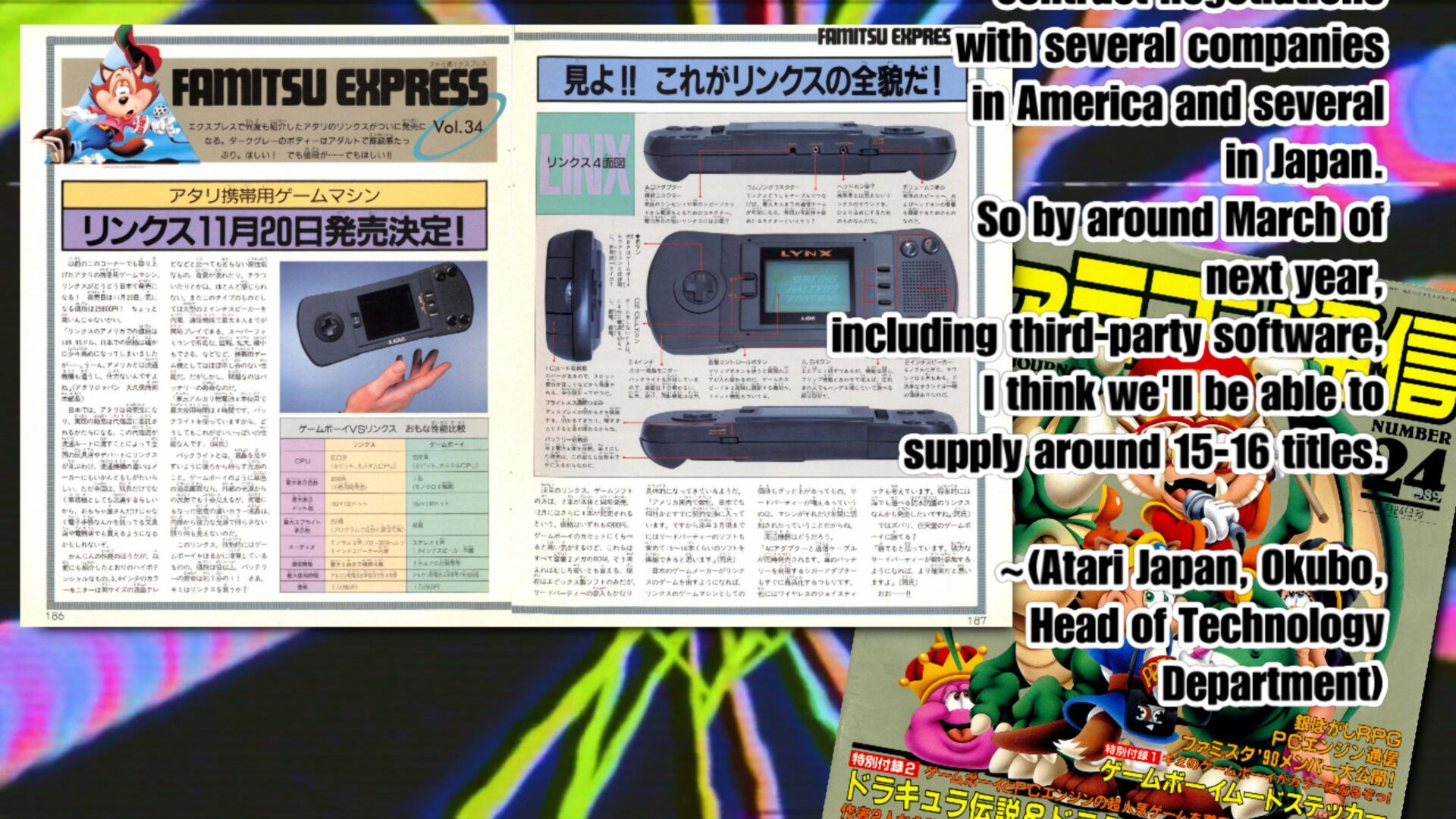
Famitsu Magazine actually ran an article the following week covering the new machine and the launch.27 They spoke to Director of Atari’s Technology Division Ōkubo who did his best to sell their console, despite Nintendo’s Game Boy having been released 7 months earlier.
“‘The US price for the Lynx is $149.95. Japan’s price has indeed ended up a little on the high side… Hmm, the distribution structure is different from America, so it can’t be helped.’ (Atari Japan, Ōkubo, Head of Technology Department)” ~ Okubo
“‘We’re already in contract negotiations with several companies in America and several in Japan. So by around March of next year, including third-party software, I think we’ll be able to supply around 15-16 titles.’” ~ Okubo
Famitsu’s article on the Lynx
Famitsu don’t hold back from questioning though, even displaying a comparison table between the Lynx and Game Boy, leaving Okubo with some tricky questions.
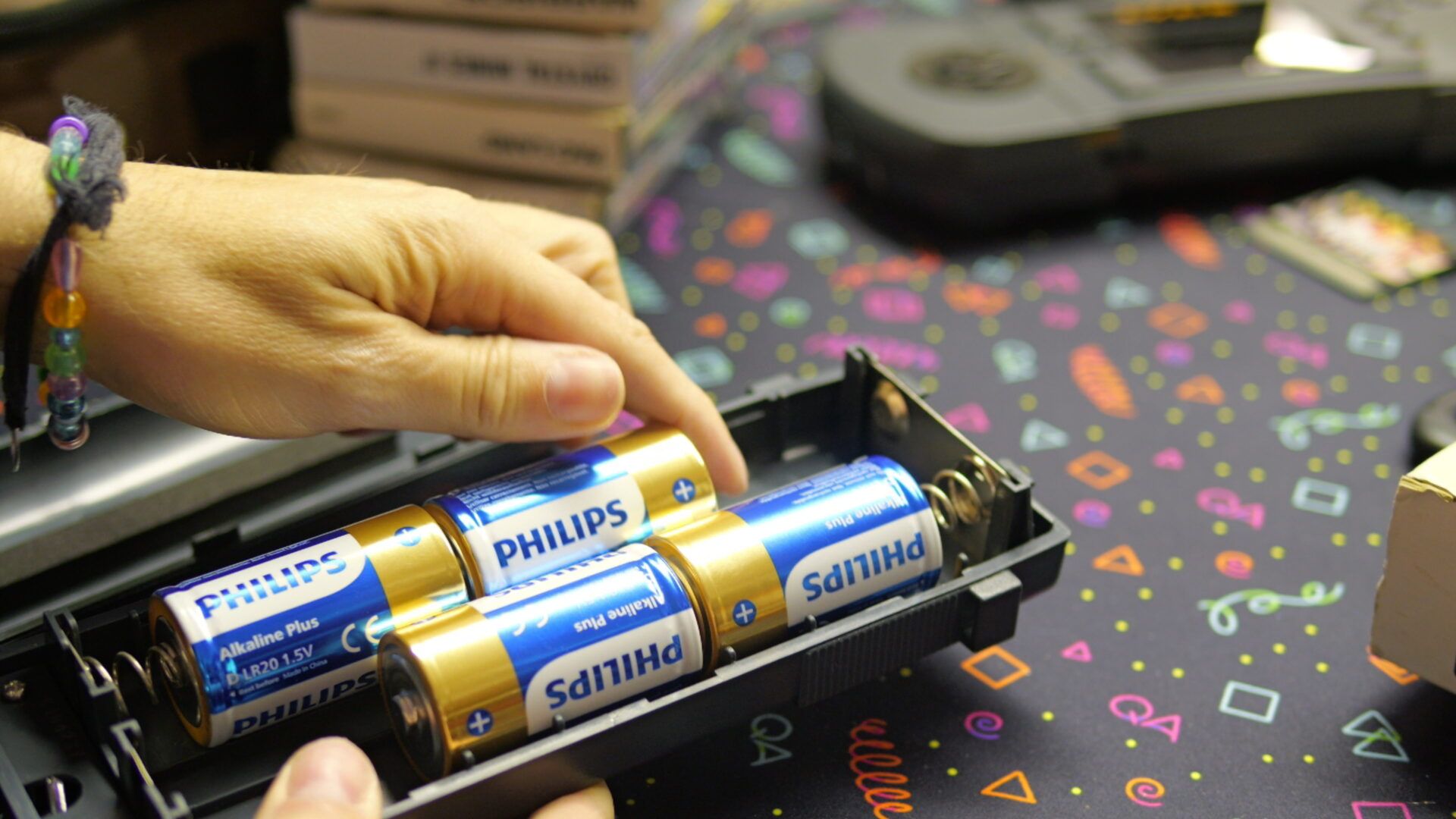
“‘Maximum playtime with six AA alkaline batteries is four hours. Because we’re using a backlight, this is unavoidably the best performance we can offer.’” ~ Okubo
He also mentions that an AC Adapter and ComLynx cable would be released alongside the system. Along with future accessories including a wireless joystick and a waterproof and dustproof Lynx that could be played at the beach.
This is in contrast with the USA who opted to include the Adapter and ComLynx with every console, in order to boost sales, however, this also where a problem had developed.
USA Second
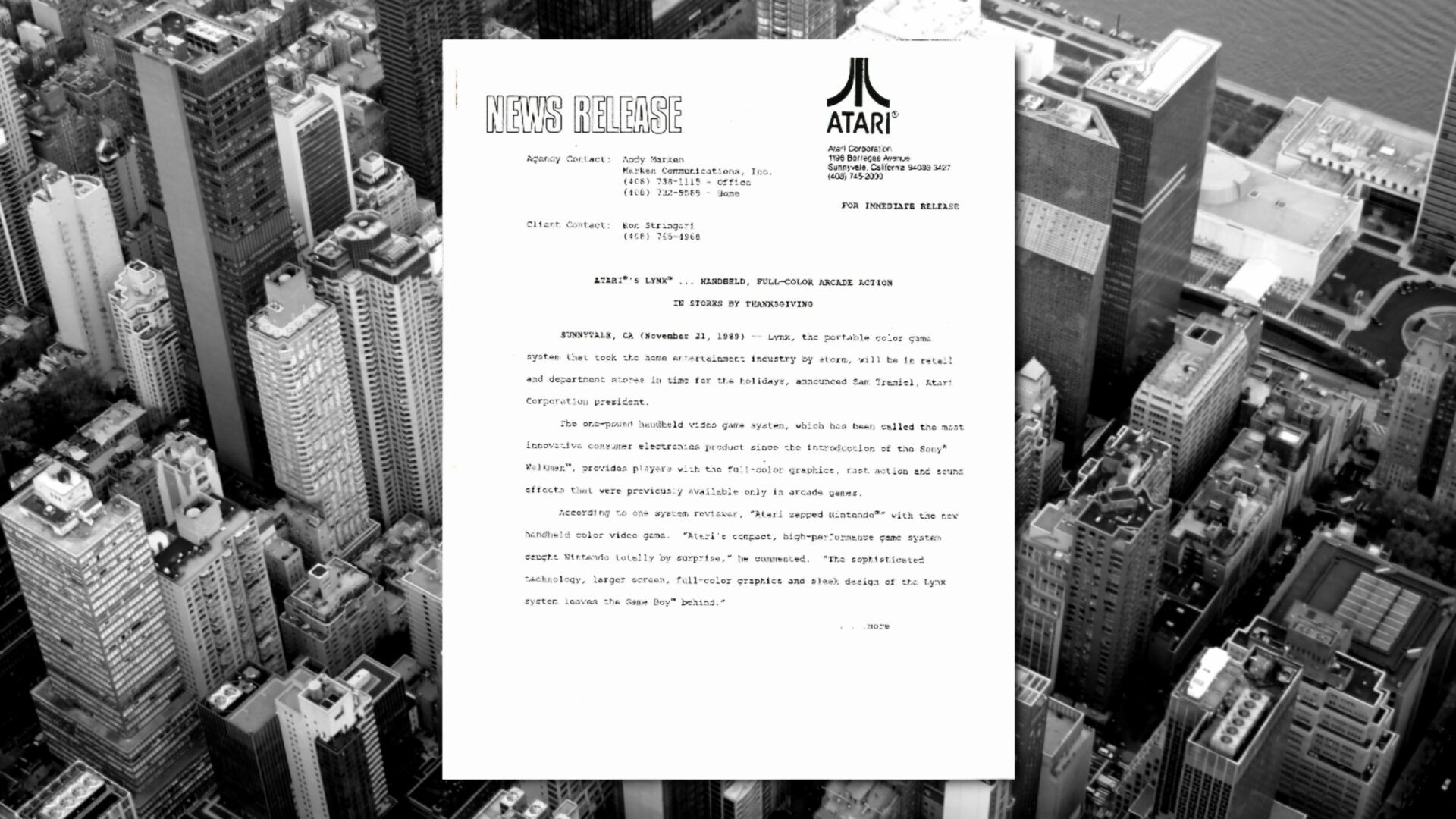
The USA launch was the very next day, 21st November 1989, with a press release selling its benefits. As discussed in Atari’s own marketing materials28, and they went all out, at least they went all out in New York. The only area to receive any stock at this point.
Atari’s News Release discussing the Lynx rollout
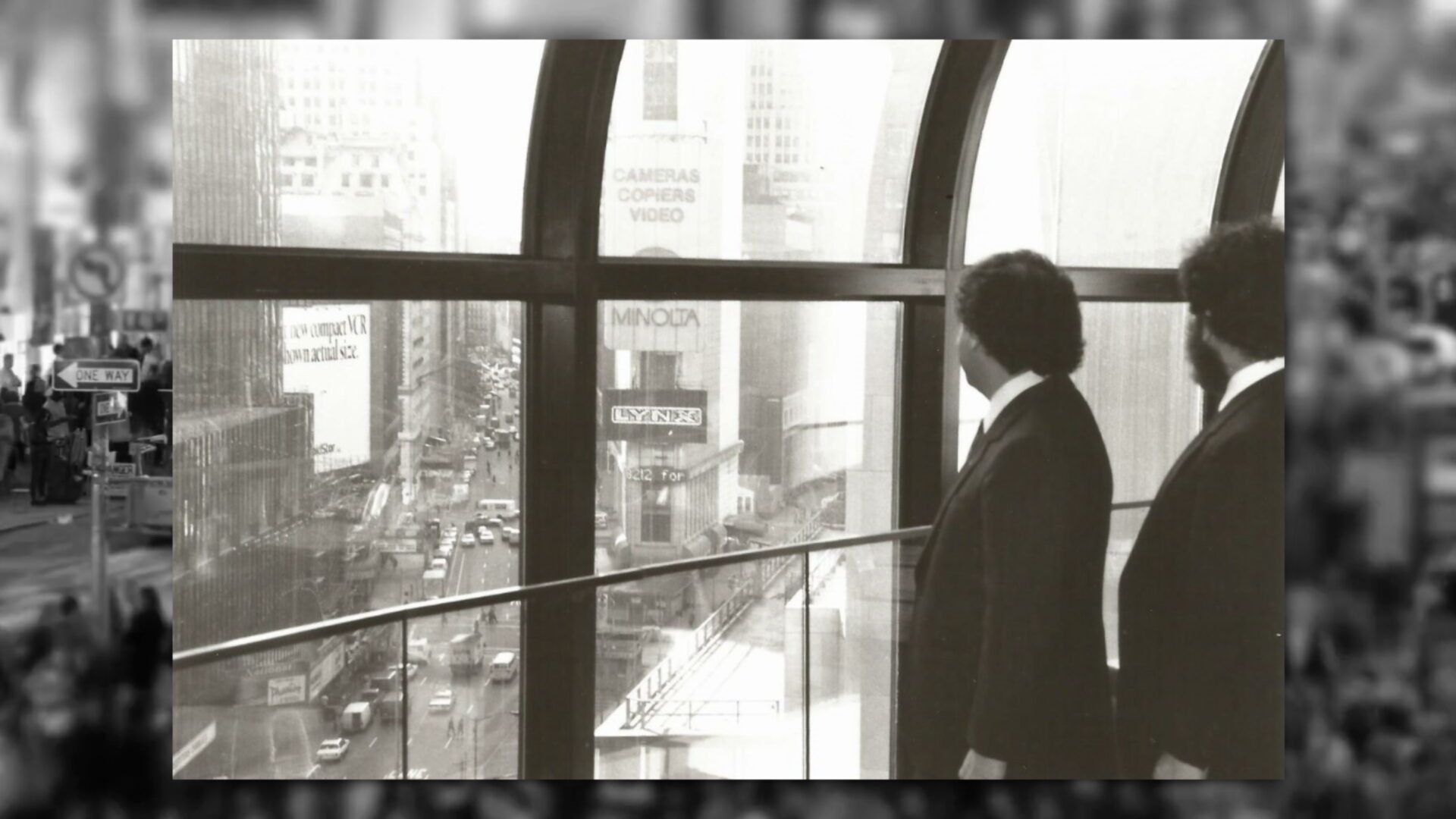
This is Sam and Leonard Tramiel,watching the first adverts for the Lynx go out over Times Square from the hotel where the launch occurred. This message would be flashed once every two minutes for two weeks.29 Limited stock was then ushered into retailers such as FAO Schwarz before the Thanksgiving Parade two days later on the 23rd November. But we don’t have records of any consoles being sold until Black Friday, 24th November 1989, where the marketing materials state.
Sam and Leonard Tramiel looking over the Times Square advert
“The day after Thanksgiving, majoy toy outlets like FAO Schwarz in New York City enjoyed a brisk business in all departments. Two days after stock its shelves with Lynx, Atari’s color portable video game system, Schwarz had sold out of their initial supply. Consumers found the smooth graphics, vivid colors and excellent sound to be an ideal holiday gift” ~ Atari Marketing
We don’t really know how many machines were available at this point, but we can derive that it was very limited numbers. Atari’s own material states;
“To help FAO Schwarz meet the consumer demand, members of Atari management hand-delivered a dozen systems and Electrocop game cartridges for the first full weekend of sales.”
A dozen.
Twelve.
Twelve systems. For an entire weekend of sales. Wow, those noble souls.
Atari didn’t provide enough Lynx machines for release
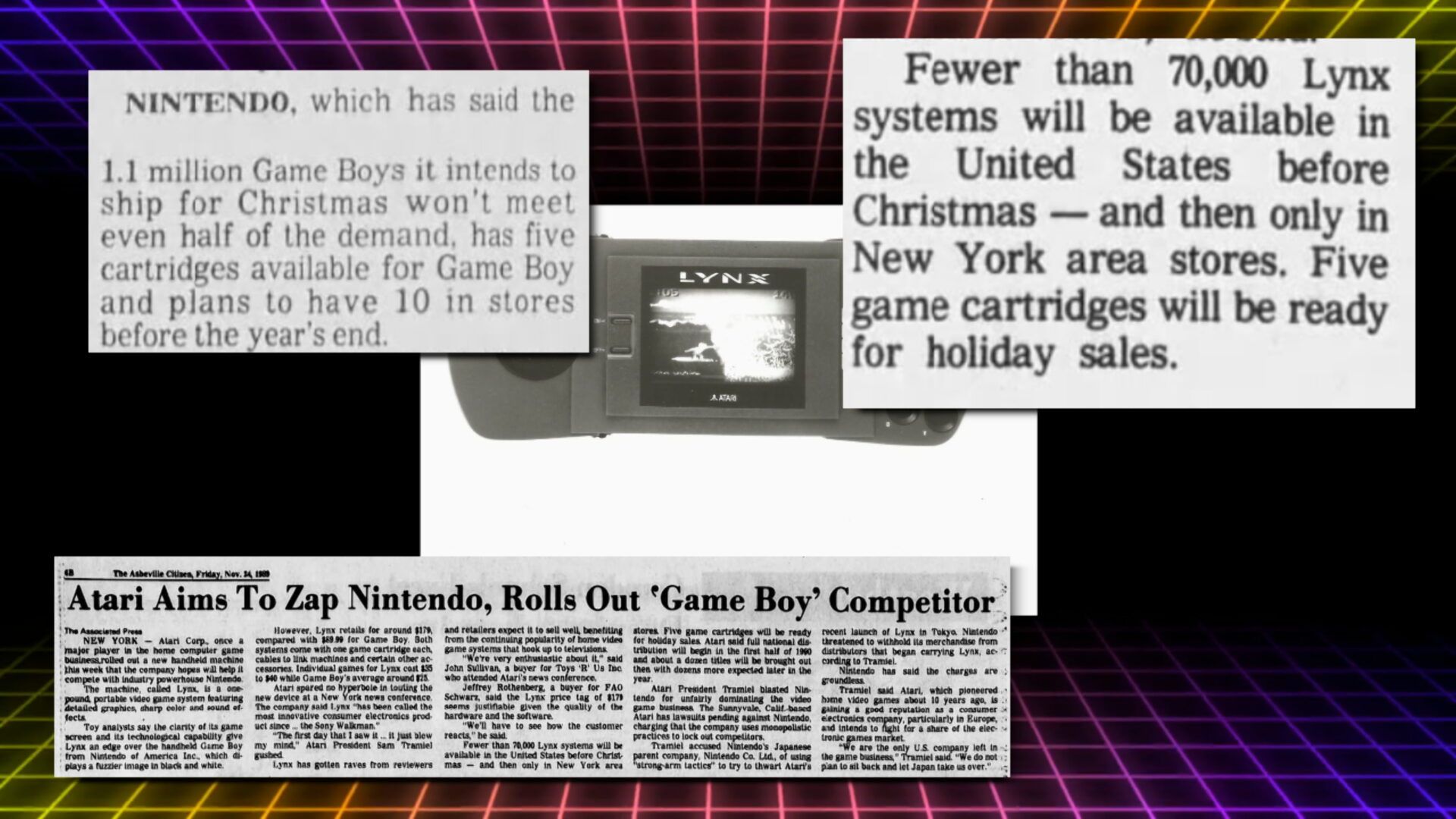
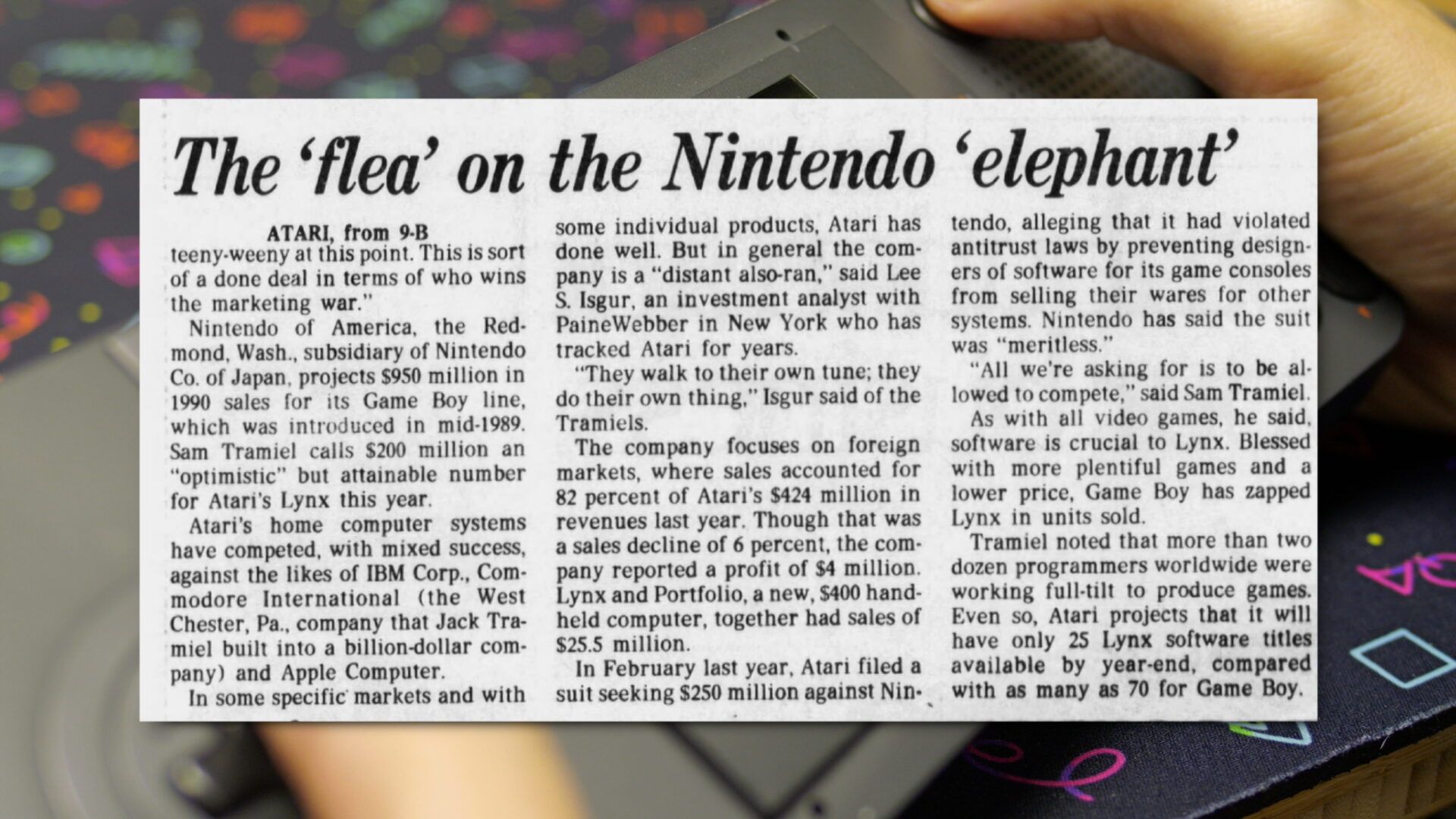
This festive season was absolutely key for the Lynx to succeed. Atari had told outlets that fewer than 70,000 Lynx systems would be available before Christmas, but this already low number feels exaggerated.30 A ghost from a company trying desperately to keep up with Nintendo shipping 1.1. million Game Boy’s for the same period, and still only meeting half their demand.31
Newspapers quickly reported on the new console arrival, next to auction houses trying to sell of parts of the Berlin Wall. Reviews were coming in for the Lynx and praising it left right and centre, with lines like “Atari zapped Nintendo” and “Atari’s compact, high performance game system caught Nintendo totally by surprise” not uncommon.
But David Wilson “Computer Buff” knew the score stating “The Atari Lynx is the pick of the ’90s… The only problem is that it may not be available in large numbers by Christmas. Atari has never been good at getting things into stores when it promises”32
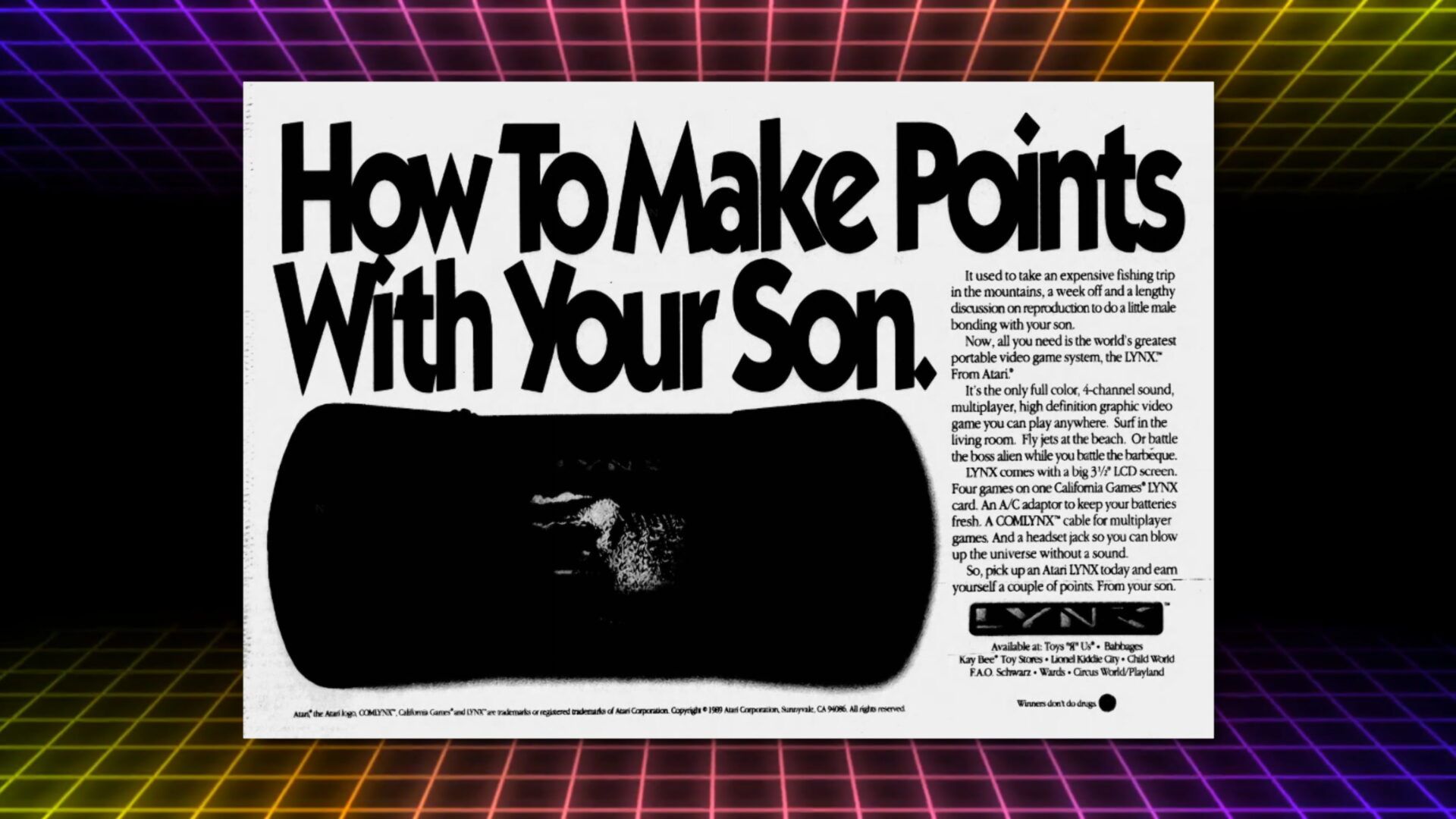
There were also adverts in all the local press “HOW TO MAKE POINTS WITH YOUR SON” stating the console was available at “Toys R US” “Babbages” (which became GameStop) “Kay Bee Toy Stores” “Lionel Kiddie City” “Child World” “FAO Schwarz” “Wards” and “Circus World”
Initial Atari Lynx newspaper adverts
But, everywhere, people were reporting that it was impossible to get hold of a Lynx before Christmas.33
Initial Atari Lynx TV Advert showing “how realistic” the console was
Back at Epyx
Atari’s biggest market had just gone out and bought Nintendo’s Game Boy… and the rest of them… well, they’d caught wind of this powerhouse Japanese console called… The Mega Drive….
Remember Epyx? Sure you do. They’re the ones who built this machine. They were also the ones now directly in Atari’s firing line. You see Atari weren’t happy with the Christmas 1989 sales. The New York and Tokyo launches were mainly so that Sam Tramiel could write things to keep investors happy in the Quarterly and Annual Reports:
“Lynx was recognized as a revolutionary achievement by the trade when it was first introduced at the Consumer Electronics Show in Chicago last summer. Shipments began just prior to Christmas in New York City and Tokyo and these two test markets were sold out.” ;~ Sam Tramiel, President’s Letter, 1989 Annual Report34
With a small footnote mentioning….
“constraints in availability and their release so late in the year resulted in a limited launch campaign.” ~ Sam Tramiel 1989 Annual Report
But really they knew that the ball had been fumbled here and they blamed Epyx for the fact that the full nationwide launches in their two key markets couldn’t go ahead.
Poor ole’ Epyx.
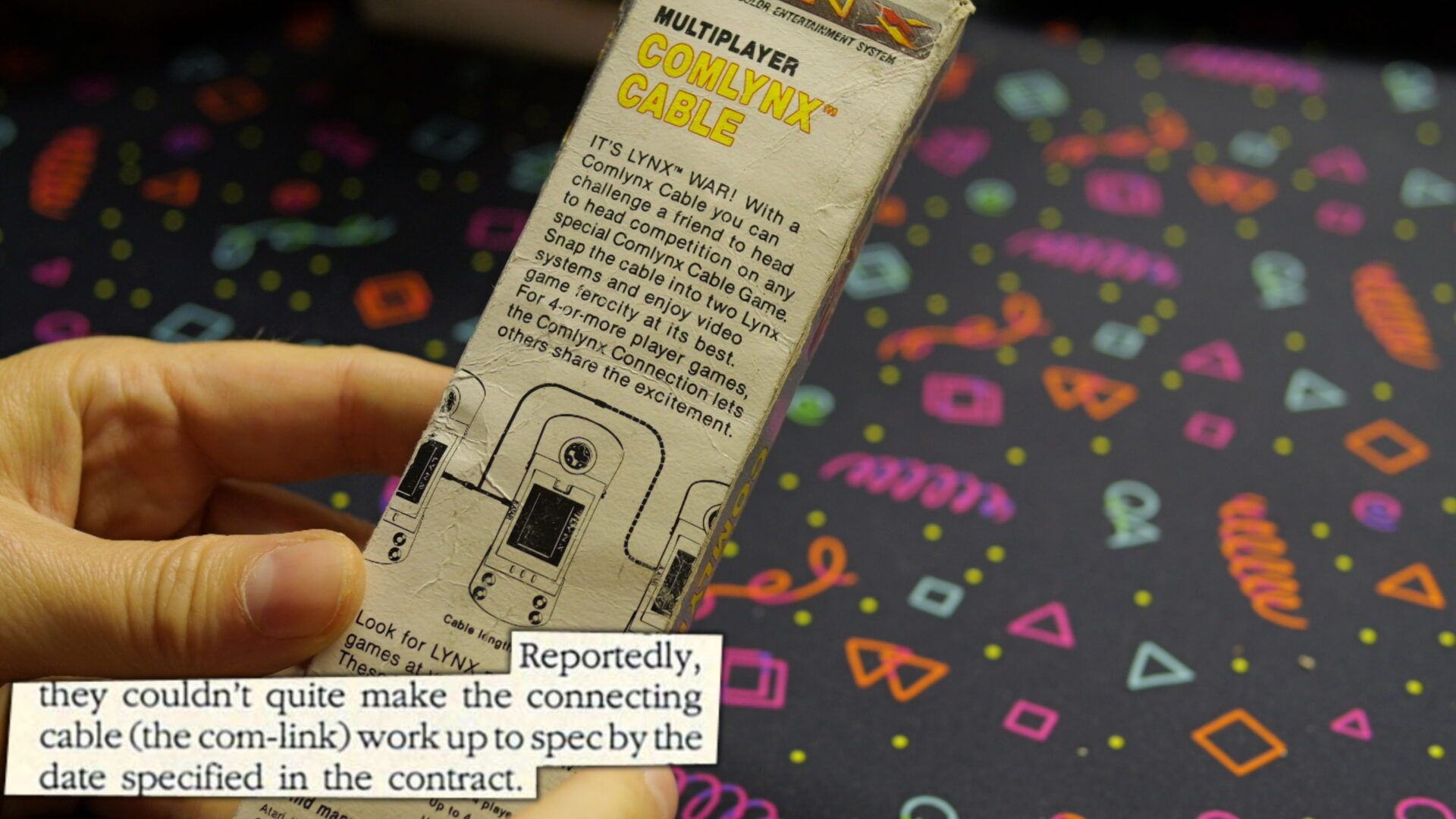
You see, Epyx had to hit those contractual milestones in order to receive payment. In a NOW Gamer Interview, Dave Needle describes a 60 day software bug-fix clause35, but the Roomers column suggests that a missed cable delivery was the breach trigger36; the cable in question being the ComLynx cable; a cable that was bundled with the initial US release, alongside an AC adapter and Epyx’s conversion of California Games.
There was reportedly an issue with ComLynx working properly
When Atari USA repatriated manufacturing from Japan to the US, they left Japan without this cable, and so initial Japanese bundles didn’t include it, or an AC Adapter, or a game for that matter. Although they did toss in the 6 AA batteries needed to power it. Which of course we’ll come back to.
With Atari withholding a crucial $2million payment from Epyx, it’s reported that Epyx filed for bankruptcy before the end of 1989.36
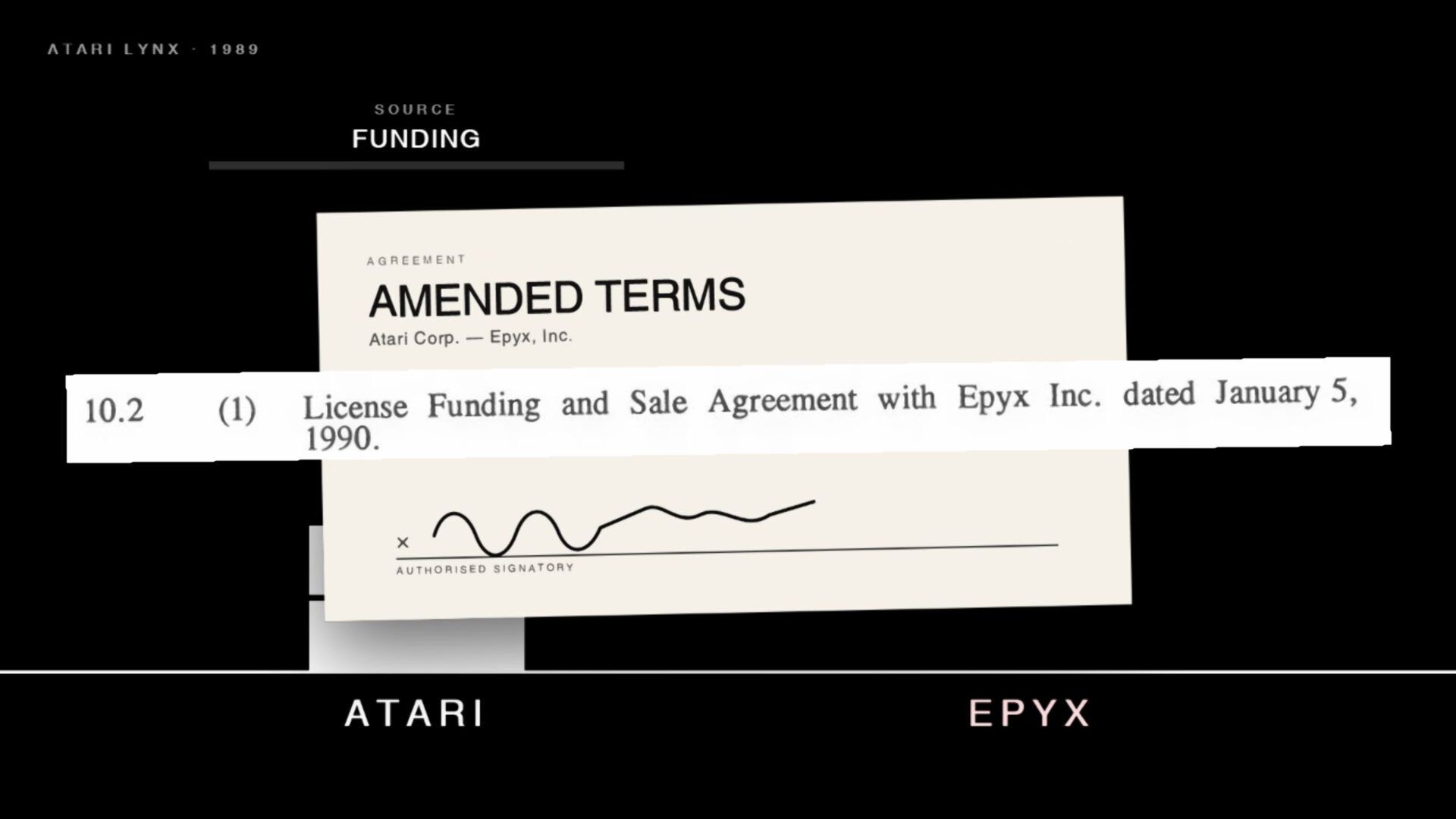
Shortly thereafter on 5th January 1990 a “Licence Funding and Sale Agreement” was drawn up between Atari and Epyx, and the Atari Lynx fully become Atari’s property.37 As part of this agreement, Atari actually paid the owed milestone money to Epyx and an additional amount to cover royalty rights.
New problems, new agreement terms, same ole’ Atari
And this seemingly saved Epyx, and allowed them to limp on with game development. But now exclusively for the Atari Lynx.
Just like his father’s Amiga deal, Sam Tramiel had seemingly lined things up so Atari could claim full ownership, leaving Epyx in their wake.
“Software support for the new Lynx has been equally impressive. In less than four months, six top game titles were released… I am pleased to say that our video game software group is currently producing exciting titles, which include some arcade hits. As many as 25 new games are planned for release by Christmas, and new hardware peripherals are presently under development.” ~ Sam Tramiel, President’s Letter, 1989 Annual Report
1990
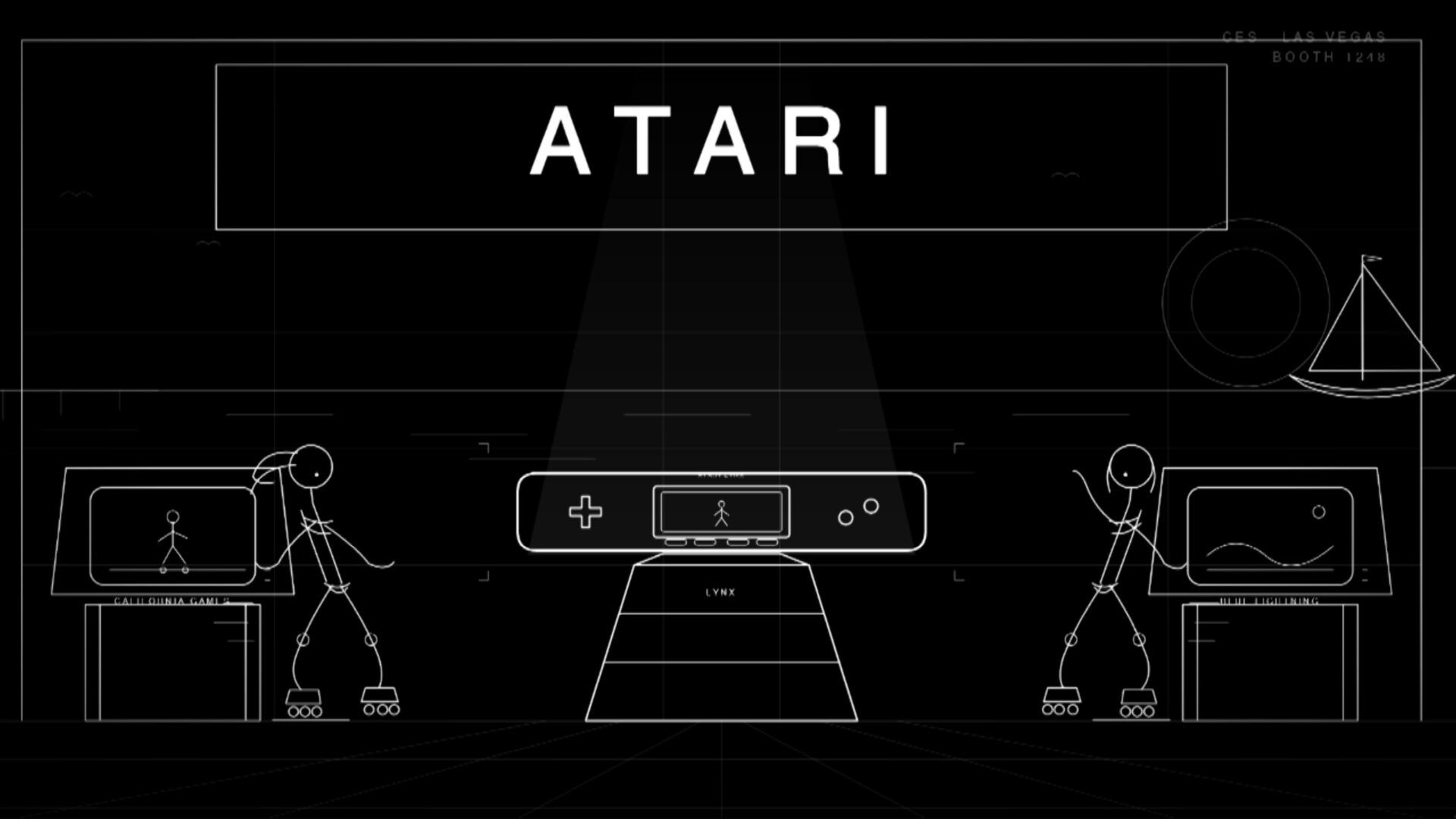
On the 6th January, one day after their sale agreement with Epyx, Atari found themselves at the Winter CES. They might not have planned to, but Epyx had already paid for a 20 foot booth in the West main hall, and so Atari now took it.
Pretty sure this is exactly what the Atari booth looked like tbh
This last minute display consisted of partially clothed women on roller skates, a small sailboat background and various Lynx consoles setup with California Games.38 This would be fantastic, had the rest of the show not been absolutely jam packed with Nintendo Game Boys, accessories for the Game Boy and developers for the Game Boy. Perhaps to shift the focus away from this, Atari invited press to The Mirage Hotel where the “real” Atari display was.
This display is where they unveiled The Atari Power Pack. The infamous Atari ST bundle that included so many games that it stopped buyers from buying anymore. Alongside that was the Atari Portfolio, The classic 2600, and of course The Lynx.
Now you might be branded cynical if you realise that the day after obtaining full rights from Epyx, is the day when The Lynx really started to appear in retailers in high numbers. But this is what happened.
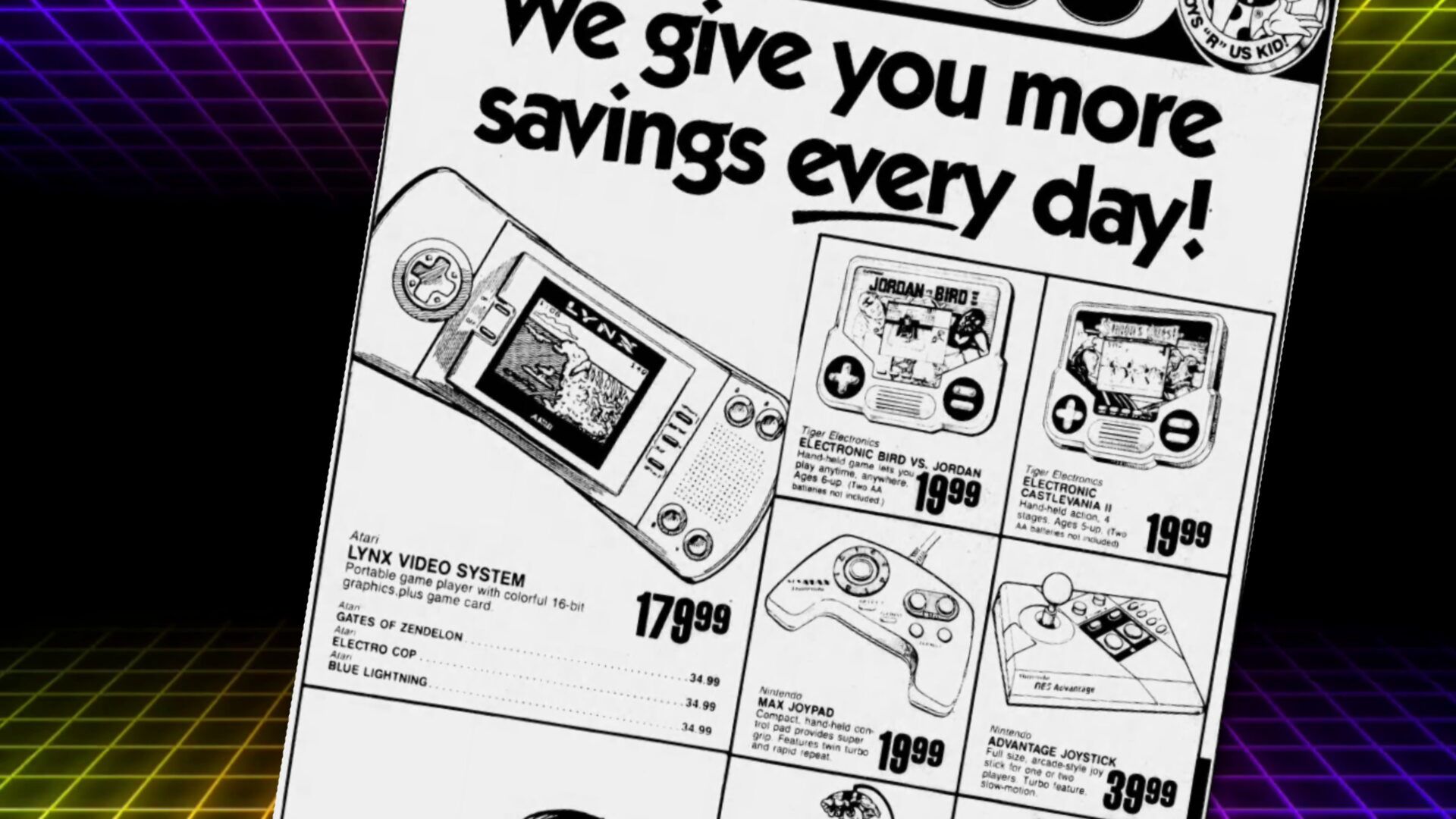
Priced at a hefty $179.95, this was $90 more than the Game Boy, and $80 more than Epyx had originally hoped to price the machine.39
Atari Lynx advertised in Toys ‘R’ Us
At this point all the developed games were by Epyx;
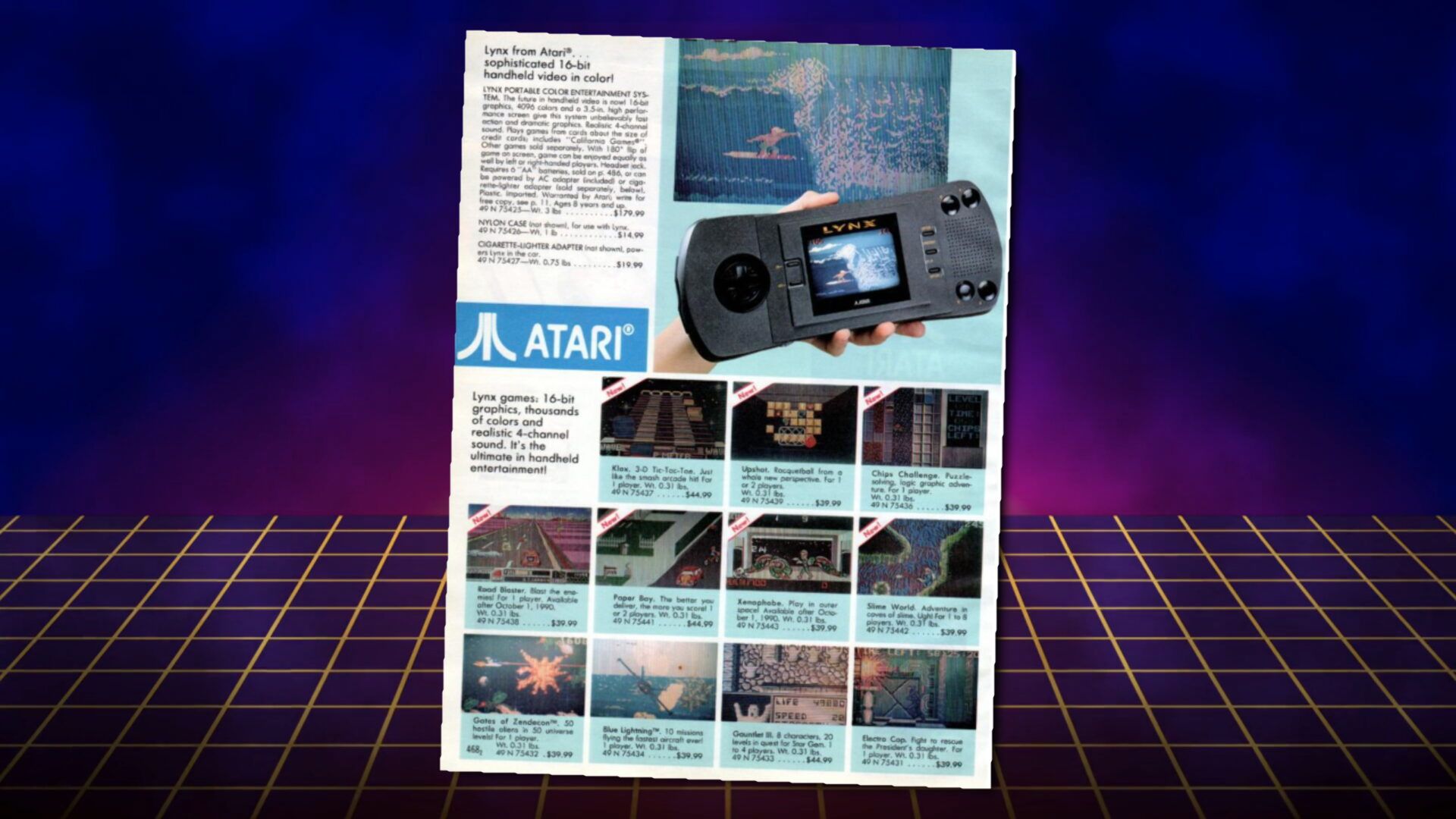
California Games, Blue Lighting, The Gates of Zendocon, Electrocop and Chip’s Challenge, with prices ranging from $34.99 to $39.99. This might have been more, had a big chunk of developers not refused to engage with Atari over unpaid debts from prior years, and the other chunk already sworn allegiance to Nintendo.40
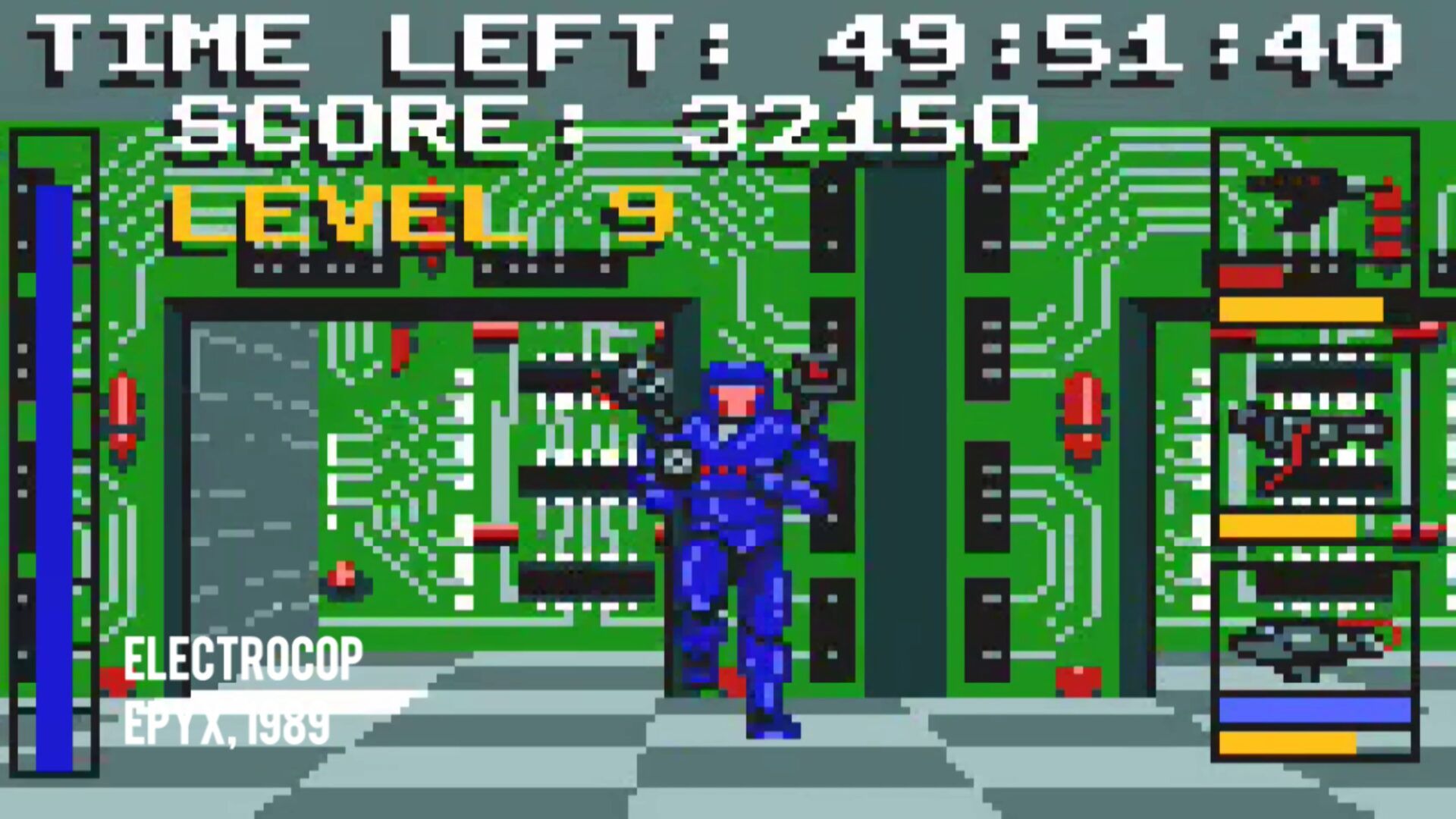
The impressive Electrocop on the Atari Lynx, developed by Epyx as a launch title
Which was a shame, because the Lynx dev kit was pretty damn good. Based around a Commodore Amiga with a Howard Board, it let coders peek into running hardware in real time. Miles ahead of anything else.41
In contrast The Game Boy had 10-15 titles, including the very recognisable Super Mario Land, the absolute perfection of Tetris, Castlevania and Final Fantasy Legend. These titles were all cheaper (around $25) and the library was growing at a much faster rate than The Lynx.
Still, Lynx games did come, some more notable than others.
And as ownership grew, reviews also started to come, again, some more notable than others.
How Lynx was viewed vs. Game Boy
Over in Japan, it was a similar story…
But Sega had been working hard on their own colour handheld and it was almost ready.
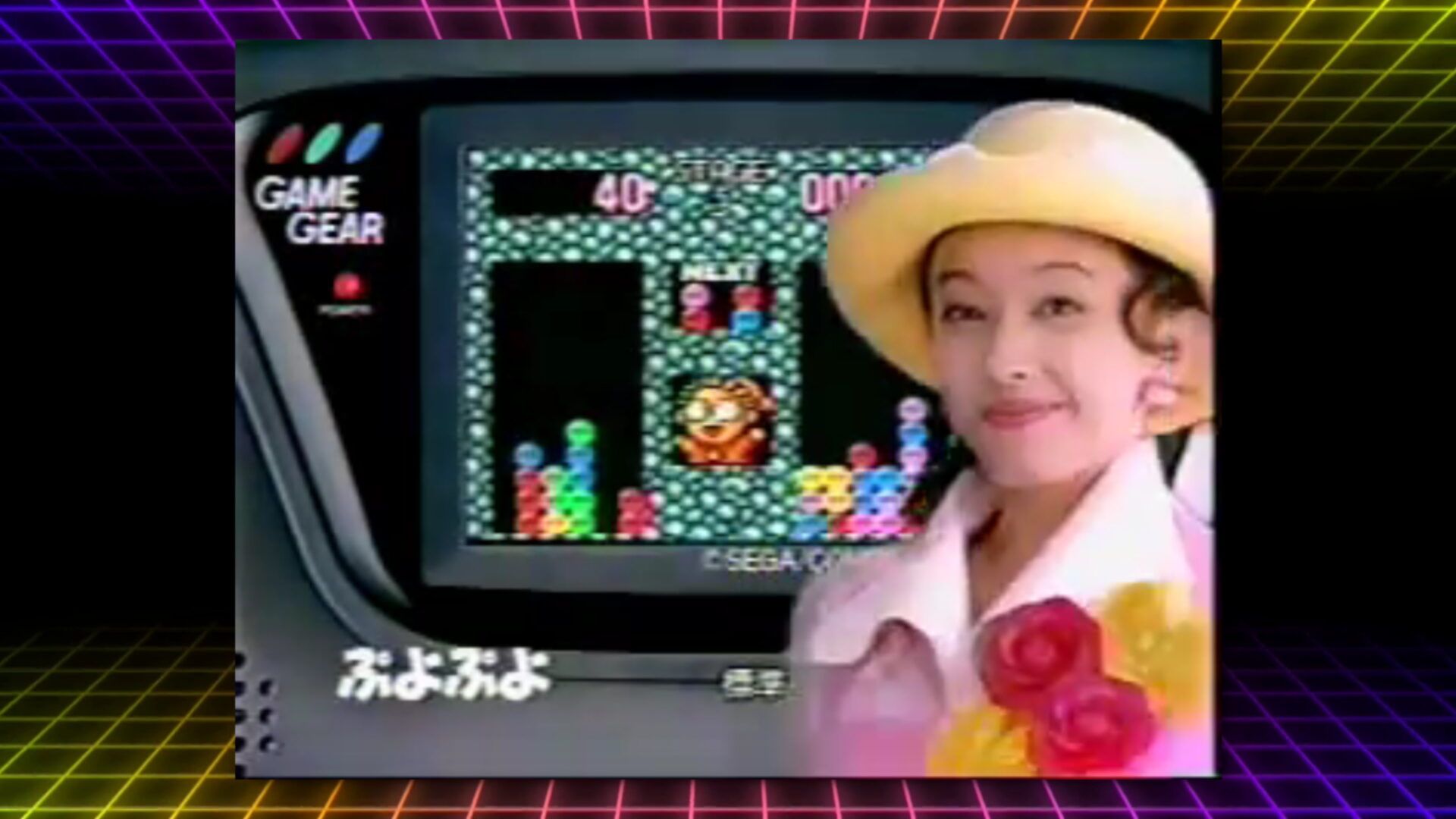
On 6th October 1990, The Game Gear launched in Japan. This was the first colour competitor to the Lynx, and it landed at 10,000 Yen less than The Lynx. The Game Gear sold 40,000 units in the first two days, 90,000 in its first month and racked up over 600,000 back orders. Plus NEC’s PC Engine GT was just around the corner.42
Japanese Sega Game Gear TV Advert
What’s more both Nintendo and Sega wre using sneaky tactics with retailers. With reports that both were telling shops that they couldn’t stock their respective consoles, if they also stocked Atari’s Lynx. Leaving the 16-bit American handheld relegated to the bottom corner shelf, or even worse, the back storage rooms.
Still Christmas 1990 would surely make up for things…
Viewers. It did not…. and to understand why, we can find some perspective from Atari themselves;
“As a result of the release of only 12 titles during 1990, and the higher launch price, sales of the Lynx were slow.” ~ Sam Tramiel, President’s Letter, 1990 Annual Report
By this point the Game Boy had around 70 titles.
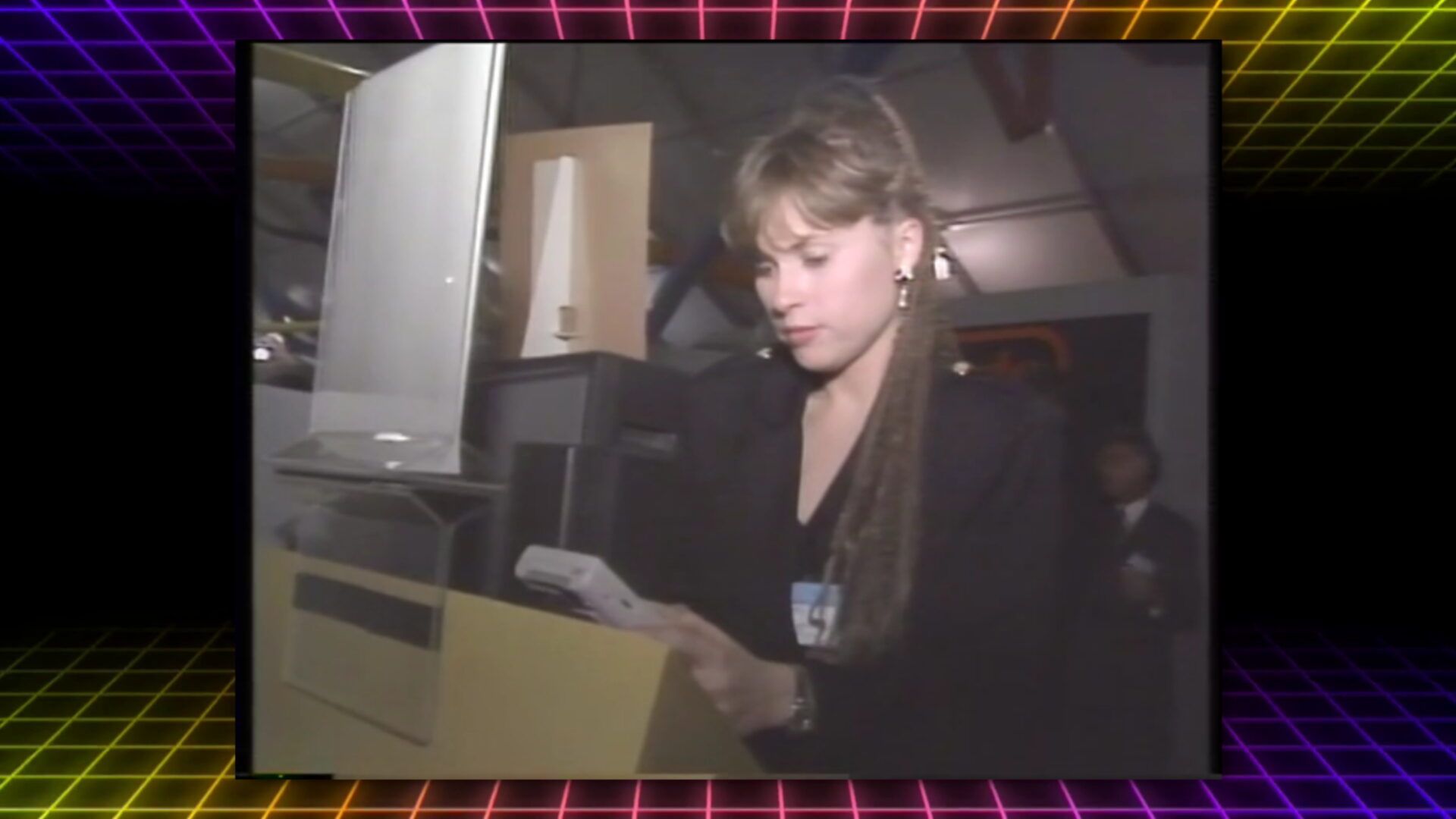
The Game Boy being used at CES
“Marketing and distribution expenses increased $5.6 million (8%) in 1990 compared to 1989 principally due to the effects of changes in exchange rates during 1990 compared to 1989.” ~ 1990 Annual Report, Management’s Discussion and Analysis
and Atari had issues with their marketing expenses, meaning that Christmas 1990, although certainly better than the previous year, was still not ideal. Reports from the time put total Lynx sales throughout 1990 at 500,000.
Their operating income of $3.7Million in 1989, turned to a loss of $25.2million in 1990, with computers still making up most of that income at 79%, compared to video games in total at 21%.
BUT, let’s remember that most of Atari’s computer sales were outside of North America. In fact 89% of their sales were outside North America, with most of them attributed to Europe, where machines like the ST were proving pretty successful in the home computer market.
This was also a market that wasn’t totally dominated by Nintendo. At least not Nintendo’s Entertainment System. Perhaps, The Lynx would slot in here a little bit better than North American and Japan.
Europe
The Lynx actually landed in the UK and Europe before Christmas 1990, but due to further launch botchery, this was after the Game Boy landed on 28th September 1990. In fact, it landed a month later, and because of that, they failed again to get the head start they needed, BUT, at least they now had a market, and a console, primed for it’s first Christmas.
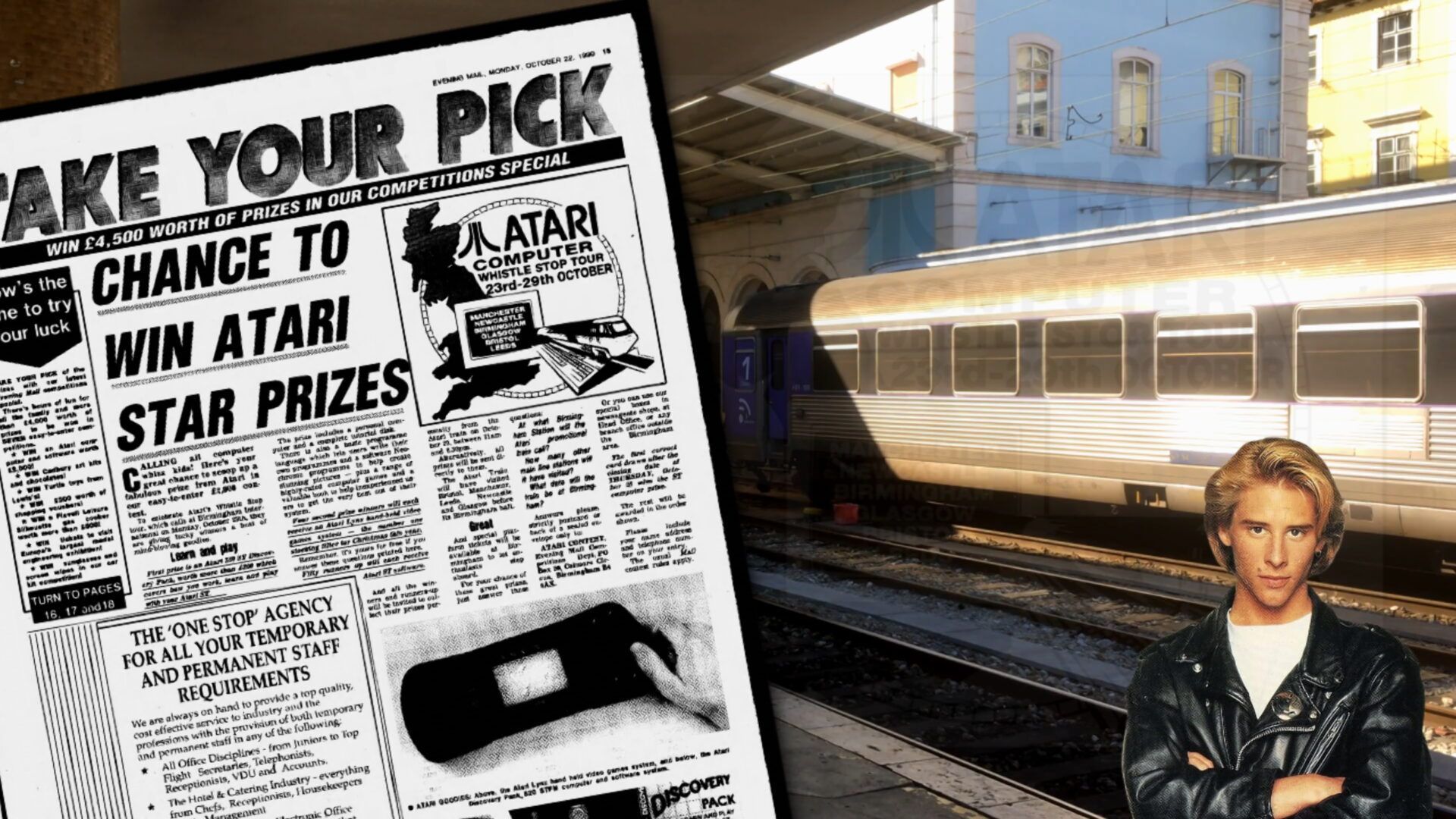
As you may expect the UK Launch was much more of a UK affair, exemplified by the Atari Computer Whistle Stop Tour from 23rd-29th October.43 Imagine for a second, filling a train with Atari systems alongside Chesney Hawkes, and then sending it to Manchester, Newscastle, Birmingham, Glasgow, Bristol and Leeds.
The Atari Whistle Stop Tour of the UK with CHESNEY HAWKES
Because that’s what happened, and you could win a piece of kit, by simply answering a couple of questions on the back of a sealed envelope and sending it in. The first prize was an ST Discovery Pack, with four second prize winners receiving an Atari Lynx hand-held video games system – the number one stocking filler for Christmas this year.
STOCKING FILLER?
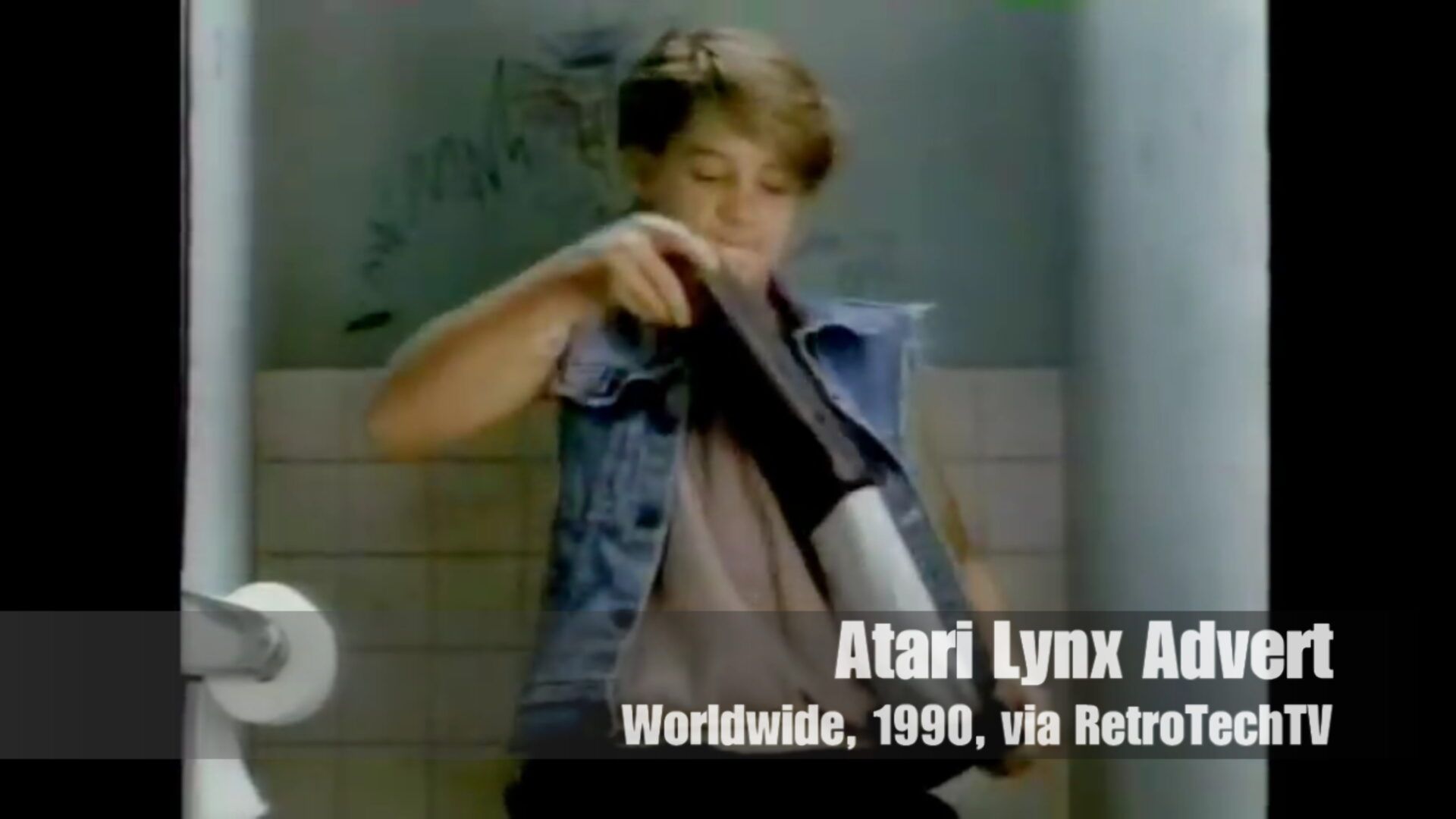
Firstly, have you seen the size of the damn thing. Don’t be fooled by Tobey McGuire’s alarmingly deep demin jacket pocket. SECONDLY, A STOCKING FILLER? How flippin’ rich were your parents. This would have been the main prize AND THEN SOME.
Don’t be fooled by McGuire
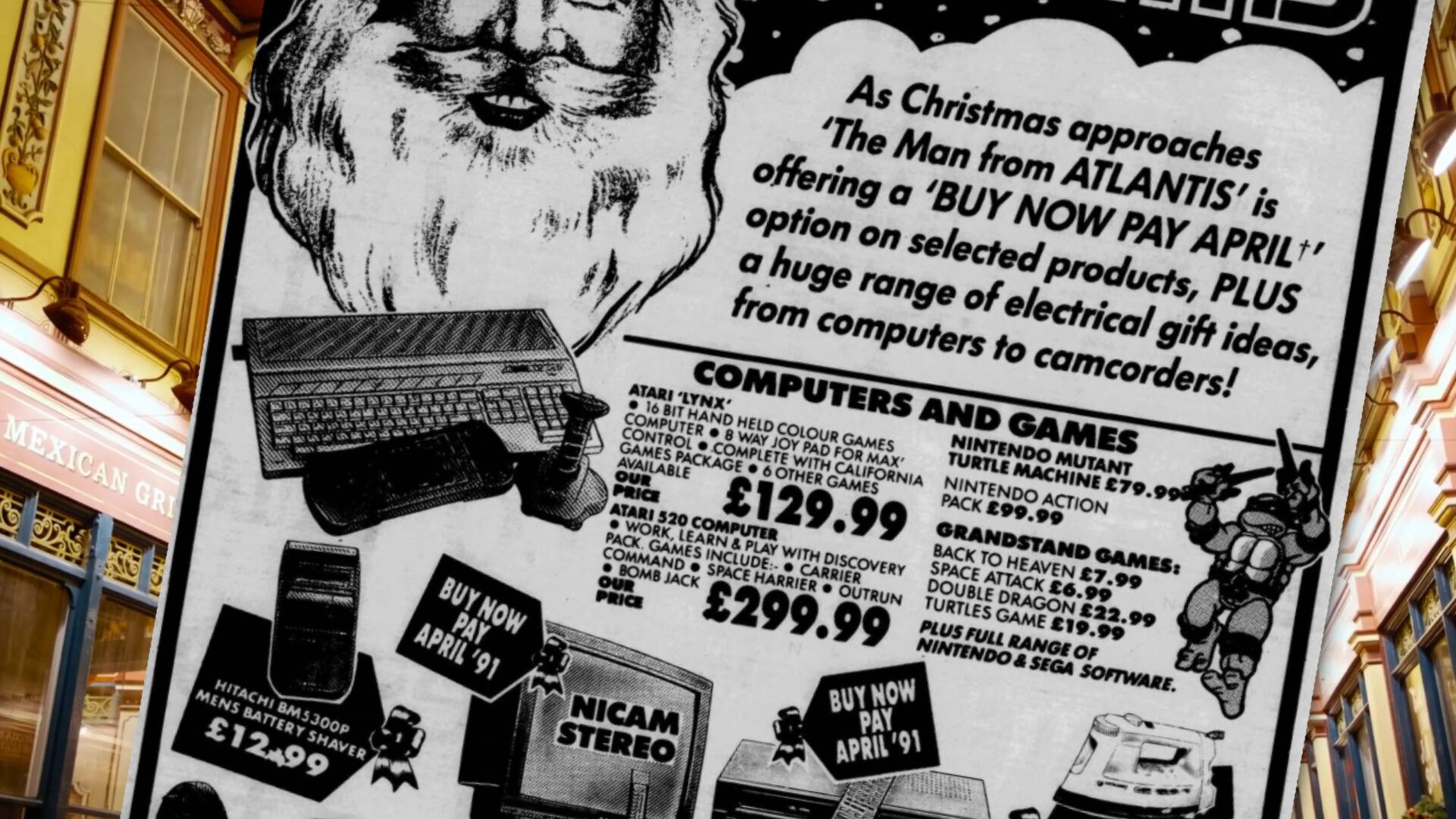
Anyway, clearly it didn’t work as well as hoped, because by December 1990, Lynxes were on sale for £129.99. A £50 reduction from it’s initial price. That’s quite a steep drop in two months, and this was pretty much the same story across the rest of Europe.
Atari Lynx price reductions quickly followed in the United Kingdom
1991
As 1991 thrust into view, Atari attended another Winter CES in Las Vegas, and came armed with the same strategy. Pricing. You could now get a hefty Lynx for a not so hefty price tag of $99! Atari also committed to releasing over 40 titles, which was really needed after 1990.
But don’t be fooled immediately. This new $99 price got you the console only, just like Japan. If you wanted the full retail bundle then slap another $30 on.
This price was certainly welcome, but it was still more than the Game Boy.
But, you see, the Game Boy wasn’t the only problem here.
The lack of appealing game titles wasn’t the only problem here.
The gigantic size and weight of the thing wasn’t the only problem here.
The Sears catalogue, showing the Lynx’s small collection of games
The miserable couple of hours of battery life, compared to 10 times the amount on the Game Boy, wasn’t the only problem here, and trust me, 90s batteries could only do the advertised four hours if you bought the most expensive, home wrecking brands available. Don’t even get me started on rechargeable batteries from that era.
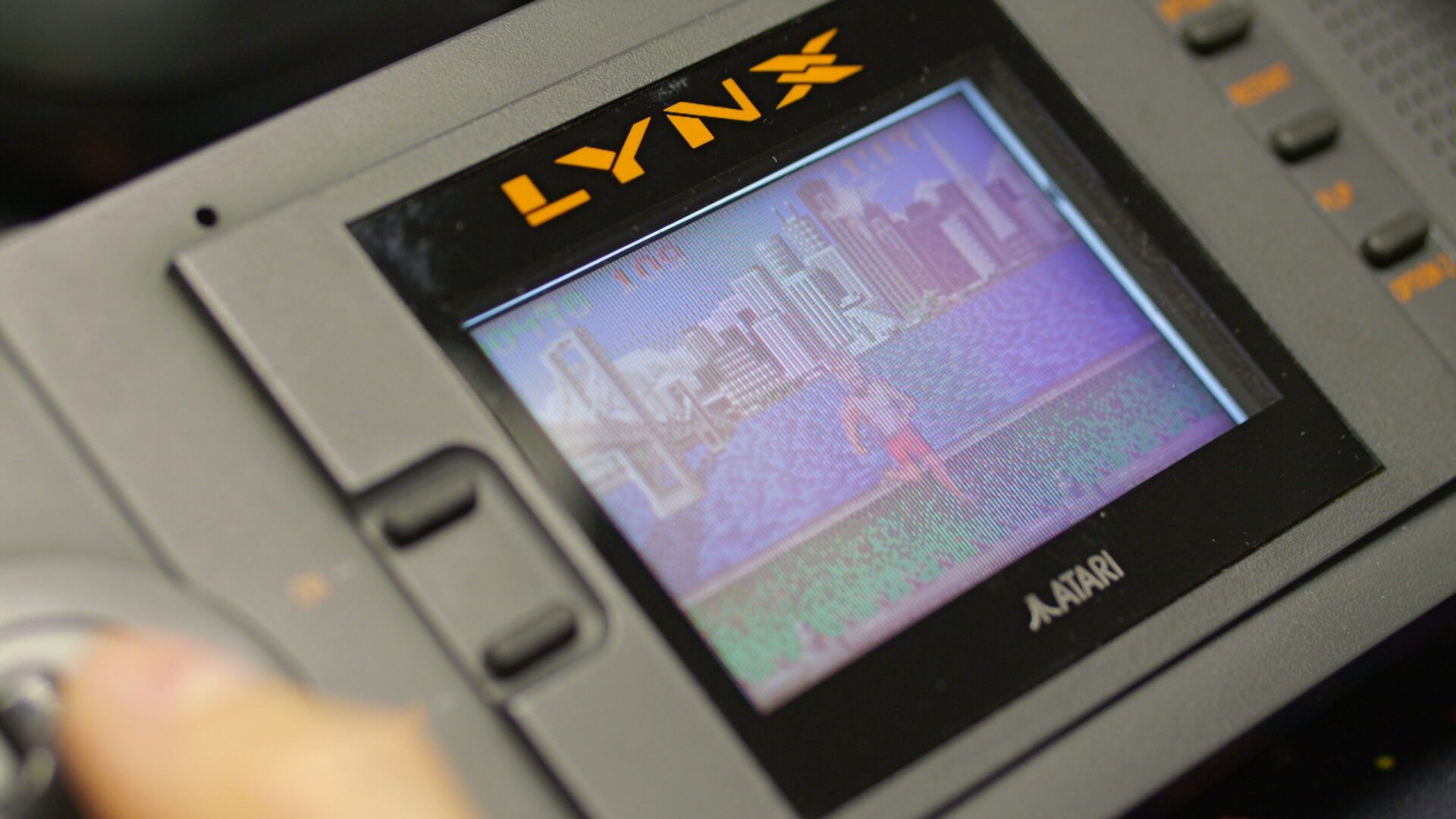
California Games on the Lynx
In fact, that’s why you could purchase this accessory, that was essentially a powerbank running on D-Cell Batteries. Just what you want to carry around alongside a cheeseboard sized slab.
The Lynx’s “Powerbank” accessory weighed an absolute metric tonne
The lack of stereo sound out wasn’t the only problem here.
The outrageous upsetting motion blur of the screen wasn’t the only problem here.
The fact that in April 1991, Sega’s Game Gear landed with a retail price of £99 or $149 and started competing directly in Atari’s color, grown up, powerful handheld space, but with more game grunt and a bigger following.
Competition was hotting up with Sega’s Game Gear launch
But at least Atari would attempt to fix at least three of those this year, and maybe, win back support.
Because let’s not forget that despite these issues, The Lynx was a whole generation of handheld ahead of its time here.
When paired with a genuinely good game, which, true to Atari’s word, we saw more of during 1991, it was an incredible experience, that in some cases could mimic the arcade. It could do things that even Sega’s new Mega Drive console couldn’t perform.
And Atari knew that, so they felt that maybe the smaller, Lynx II could help convince folks.
The Lynx II
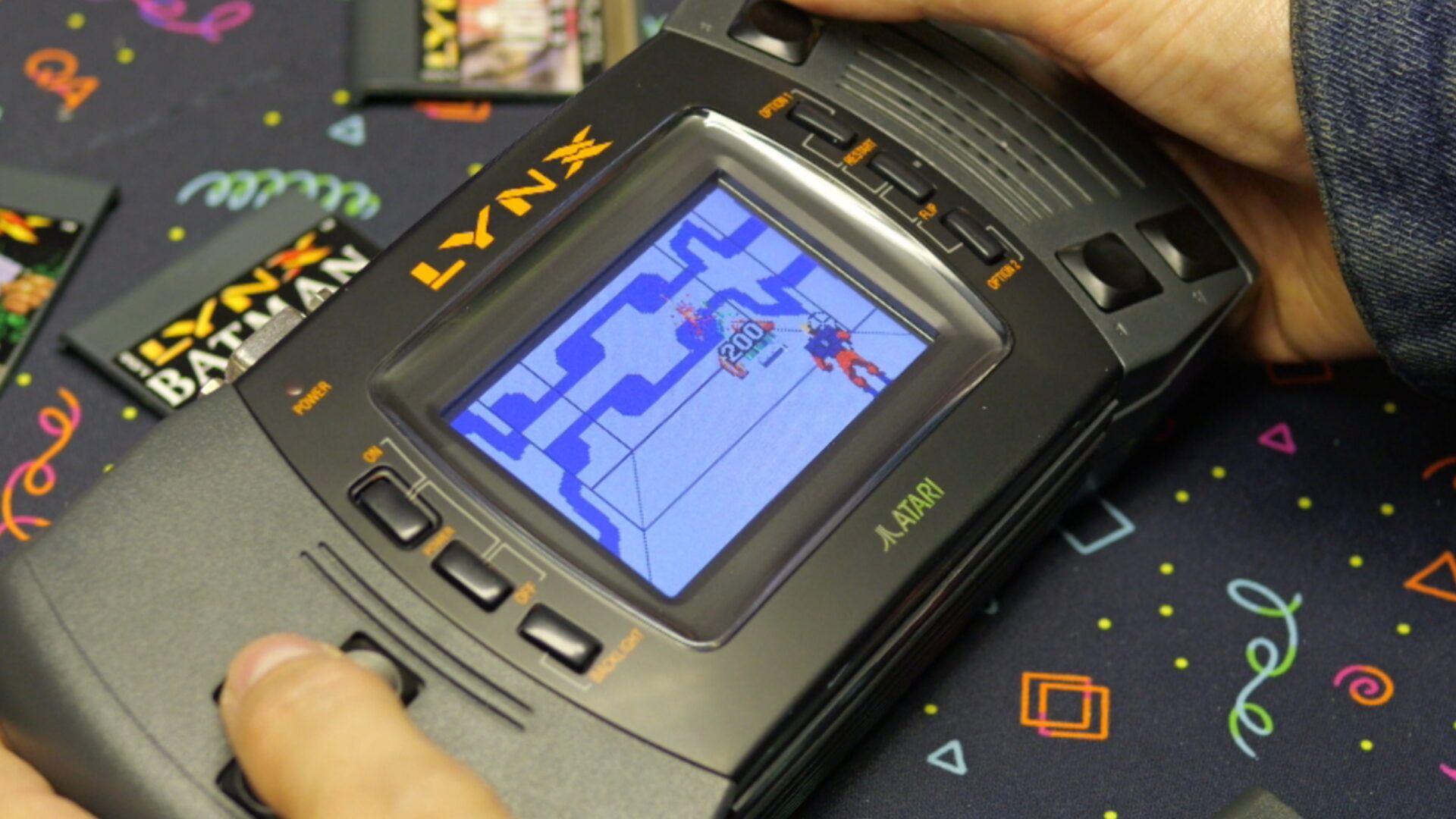
The Lynx II was smaller, lighter, had a slightly longer battery life; thanks mostly to a screen where you could turn the battery hogging backlight off. It had a less tinny speaker, a power LED, Stereo headphone output, a better grip AND a more reasonable price point
A boxed Lynx II looking glorious in its boxedness
Andy Marken, had been in charge of promoting the first Lynx too, but Sam Tramiel repeatedly sacked and brought him back. Now head of PR firm Marken Communications, he was in charge of promotion over in North America, and in his “Six Years With Atari” memoir he recounts the launch;
“Just before the following Thanksgiving, we introduced the Lynx II that had a better feel, way of handling cartridges, battery life and a lower price. We showed it off at the Marriott Marquis in NYC overlooking the Times Square digital sign we rented for the occasion. While a young lady on our team trudged through the slush delivering seed review systems to radio, TV and print folks; Sam, other team members and I had back-to-back interviews. Most reviewers wouldn’t let the new Lynx go, so Sam was happy to offer them a special editorial discount and have the unit overnighted to them. Suffice to say, everyone was happy ; except the gal with the wet, cold feet.” ~ Andy Marken, Jack Tramiel Family ; Six Years With Atari, dayintechhistory.com.44
Marken’s recount puts the Lynx II launch around October/November, which is corroborated with when advertising for the console starts appearing in media at the time, although just like the first console, it was announced earlier in the year, in a bid to try and compete with Sega’s new offering.
Just like Clive Sinclair, Atari seemed good at announcing things without delivering the goods.
With a UK retail of £99 and a matching US retail of $99, this model was priced to sell. Even so, we quickly see retailers cutting the price for the Christmas 91 season.
The Lynx II quickly dropped in price
Reporting the Facts
To understand what impact The Lynx II had, we really need to look at Sam Tramiel’s words again in their annual report;
“As I noted in my message last year, we reduced the retail price of the Lynx to $99. As anticipated, unit sales increased over 1990 by 80 percent. This increase, together with the forty-two software titles now available, is positioning this product as a major contender in the portable category. For the upcoming Christmas market we will have about 75 titles. In a number of countries throughout Europe and in the U.S., we introduced new advertisements and T.V. commercials during the fourth quarter. These new consumer messages proved successful and will be carried forward in 1992. Our software development continues to be strong and we are licensing some major titles, such as ‘Batman Returns’.” ; Atari Corporation Annual Report 1991, To Our Shareholders.45
An increase in over 80% is not to be sniffed at, and it certainly put The Lynx in a new light. Most of these sales we can attribute to the price drops of the original model and the excitement over the new. Trade Press reports in late 1991 estimate that The Lynx had sold 800,000 units, which Atari claimed was in projections.
However, when talking about the company as a whole, Tramiel is less enthused.
“After lengthy consideration, I decided to present this year’s message to you in a direct, straight-forward way. I am quite displeased with the company’s 1991 results, and hope that this message accurately conveys my dissatisfaction, and the corrective actions we have implemented… My desk is where the buck stops.” ~ Atari Corporation Annual Report 1991, To Our Shareholders.
Atari were losing money at an upsetting rate
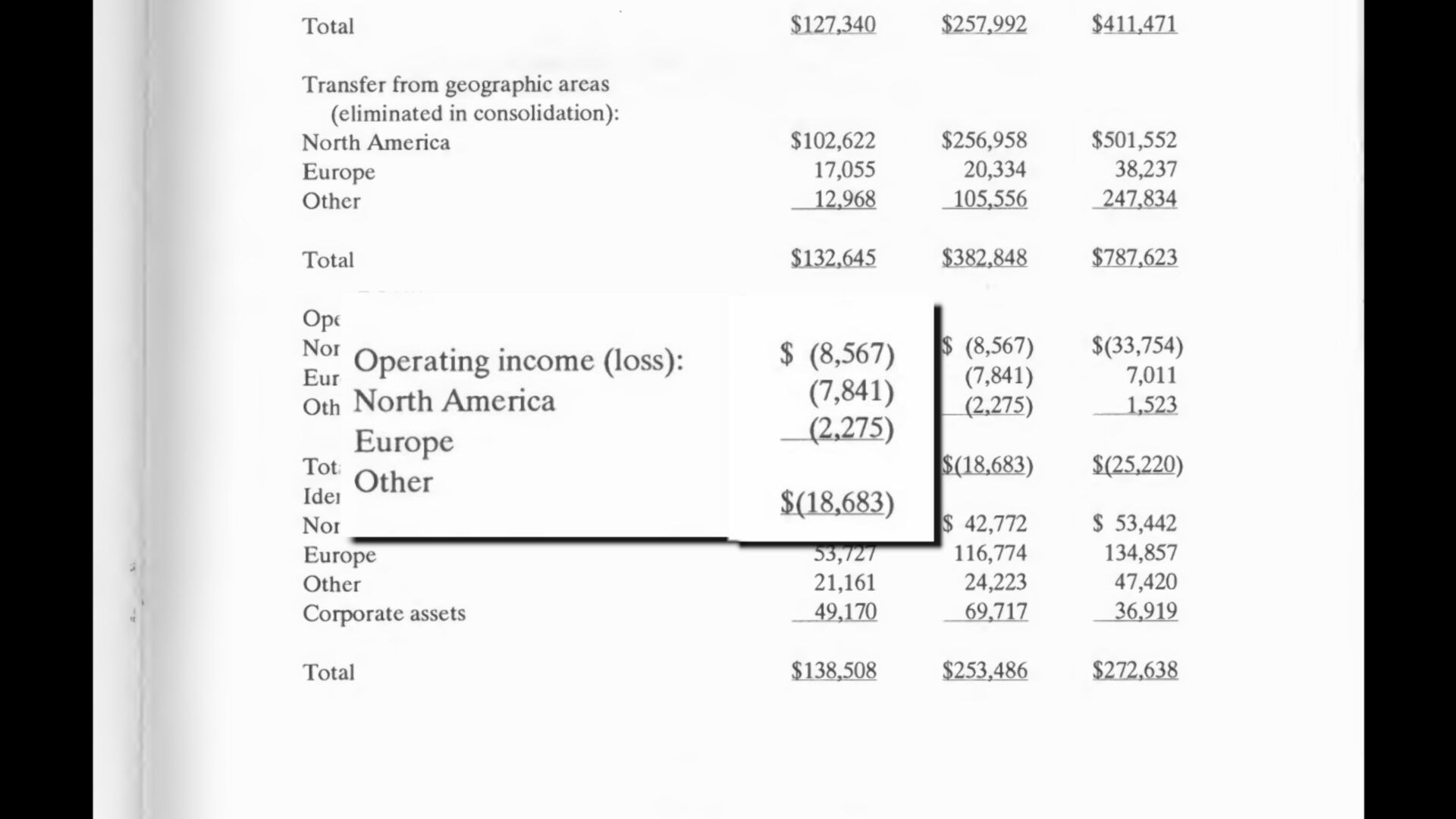
Although on paper, 1991 had a net income of $25.6million, this was mostly due to the sale of their Taiwanese manufacturing facility for $40.9 million. If you take that out and look at their Operating income, we get a loss of $18.7.46
1992
It’s clear Atari were now struggling, whilst their main competition were going from strength to strength.
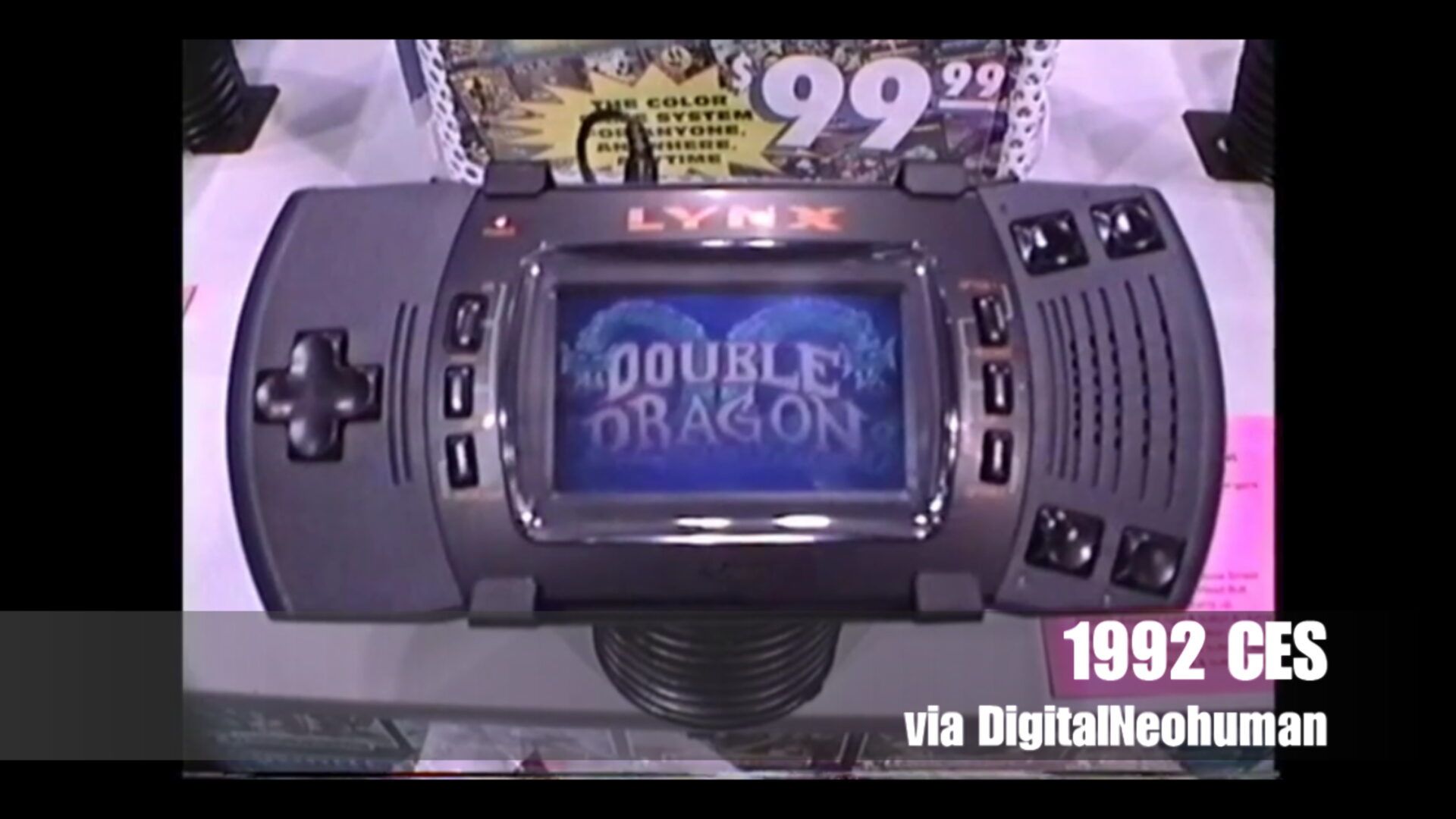
1992 starts with another Winter CES. The Lynx II is on the stand. It now has around 50 games, and the year is looking rosy.
The Lynx II as demonstrated at the 1992 CES (via DigitalNeohuman)
Apart from the fact that it’s not.
Sam Tramiel and Atari have a lot on their plate, chief amongst those are his father’s management methods catching up with him.
Back in 1987 Atari acquired the consumer electronics retailer Federated Group and never really knew what to do with it. On 23rd January 1992 an involuntary petition lands on their doorstep. The bankruptcy is separate to Atari Corp itself, but still has an impact.47
In 1989 Atari had filed an antitrust case against Nintendo, on the basis that Nintendo illegally restrained and monopolised the markets for home video consoles. Something Sam Tramiel would often reference it, and had poured years of management time into it. In February 1992 the case could come to court and by April, Atari had lost.48
In essence this was in part why the Lynx had suffered. Nintendo had tied most of the Japanese publishers into exclusivity arrangements. Sega mopped up the rest and Atari were left by themselves. If only they’d signed that Atari Mega Drive deal.
On the 4th March a Texas Jury awarded $2.245 million against Atari and Federated in Scott Campbell vs. Atari; an emotional distress claim from a former employee. It was covered by insurance, but yet another management distraction.49
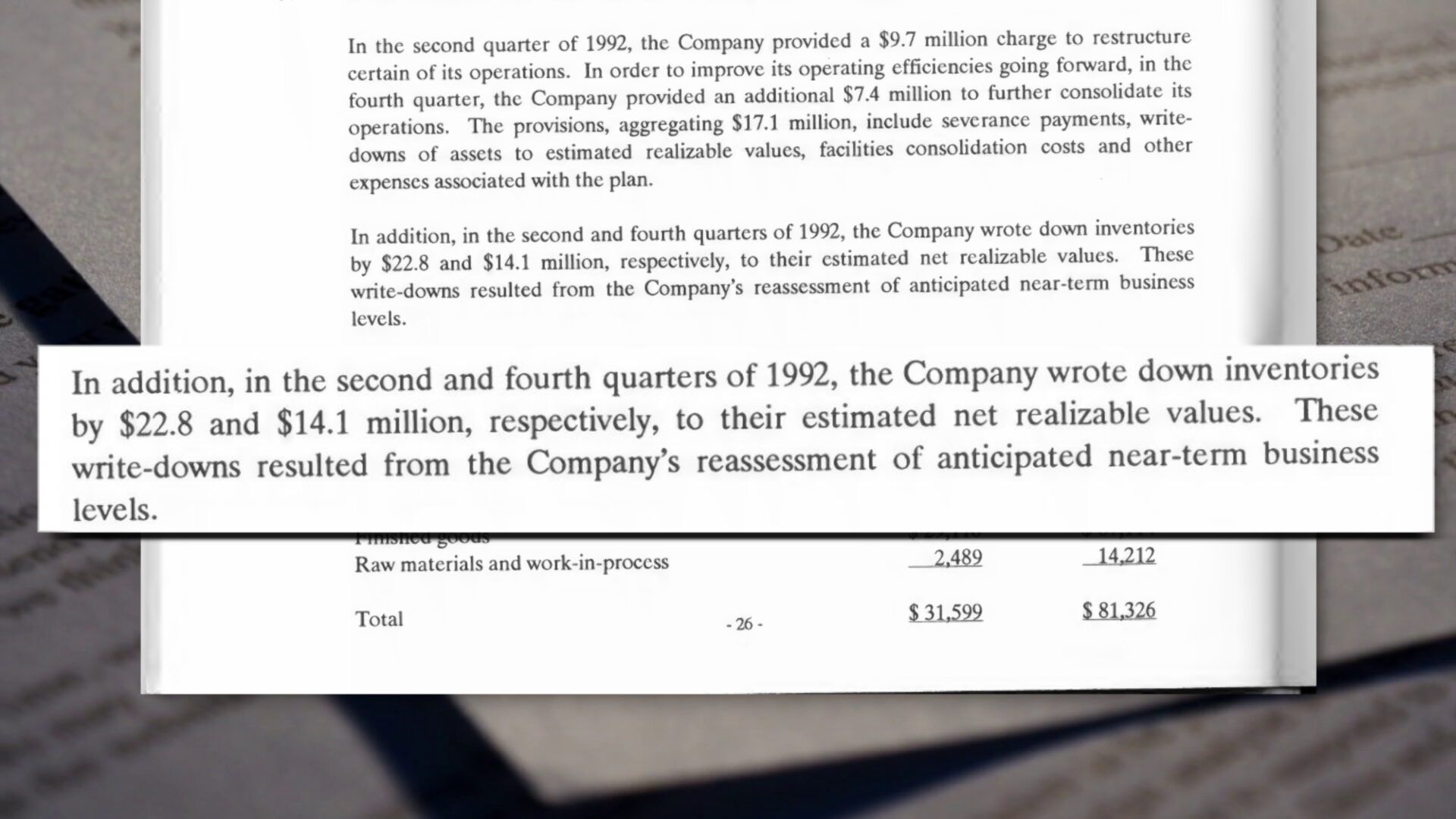
In the second quarter of 1992 Atari took a $22.8 million inventory write down for old ST stock, their 2600 consoles, basically anything that wasn’t forward looking to the Lynx, their brand new and powerful computer in development known as the Falcon and their new in development console, The Jaguar.50
Inventory write-downs became common place for Atari’s stock
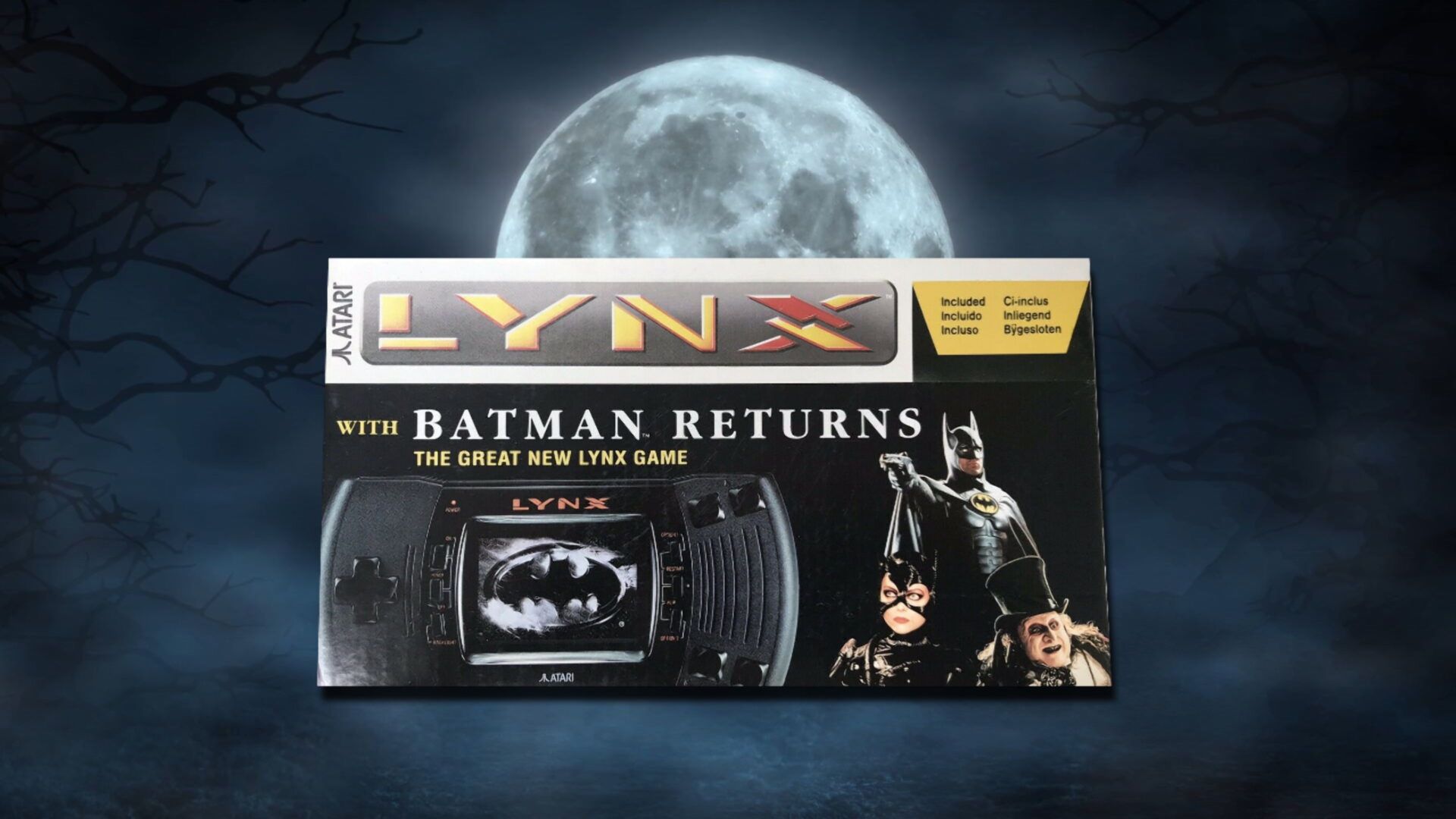
On 19th June, Tim Burton’s Batman sequel premieres; Batman Returns, and for once Atari has timed things perfectly. Their software division had been hard at work on The Atari Lynx movie tie in, and it was ready to release alongside the film. In celebration they also launched A Batman Returns Atari Lynx II bundle. This is the closest thing The Lynx had come to for a big name, mass market tentpole release, and Sam Tramiel was placing a lot of his hopes upon it.
Batman Returns offered The Lynx II a glimmer of hope in a sea of despair
As movies did back then, Batman Returns hit UK cinemas a month later on 10th July. Daryl Still, Atari’s UK Marketing Manager is quoted in Retro Gamer issue 129 for their Lynx 25th Anniversary feature;
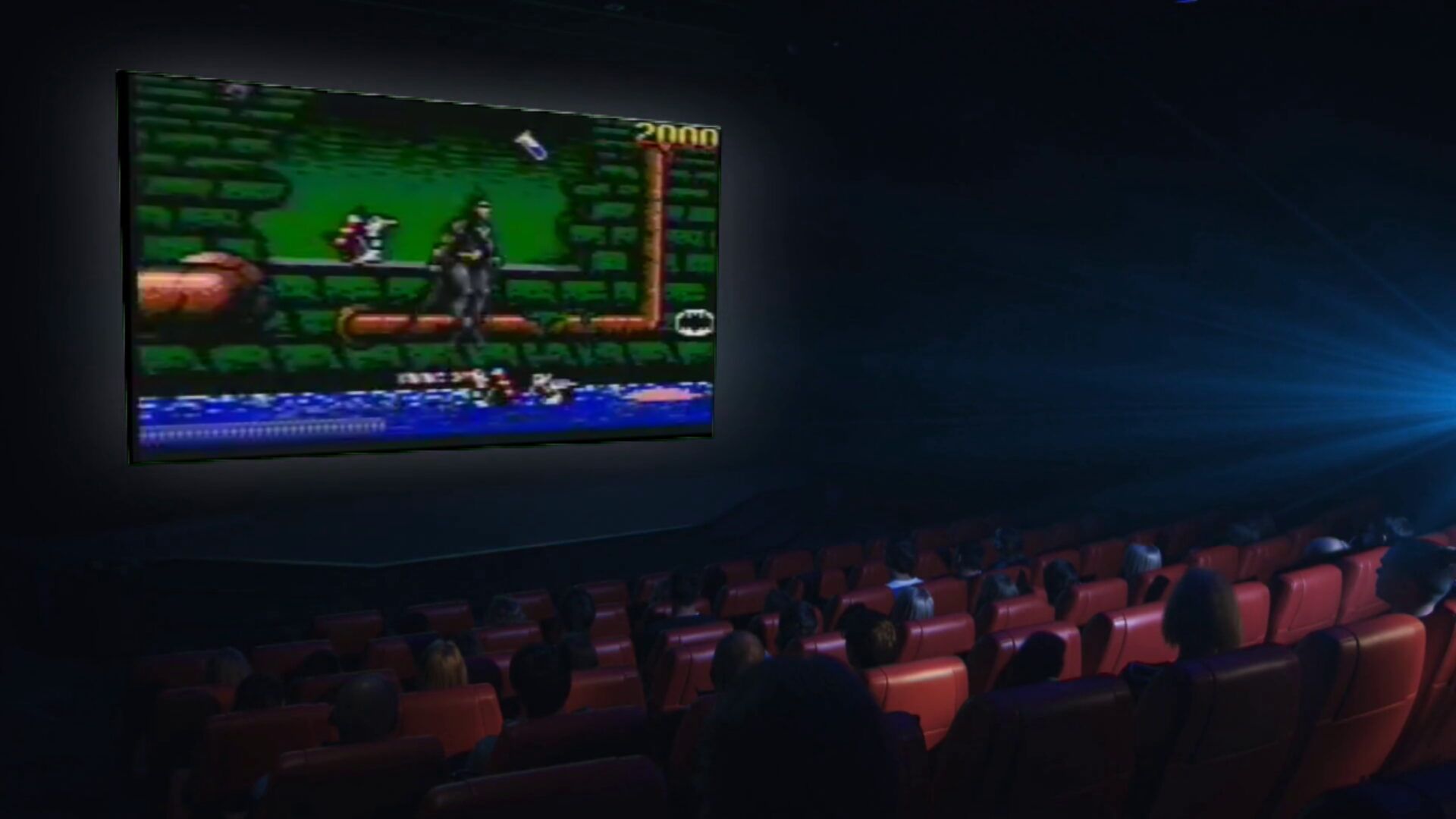
“I remember going to the movie premiere in Leicester Square and hobnobbing with the likes of Bob Geldof and Paula Yates and Catherine Zeta Jones and John Leslie on the red carpet. The big issue with the advert was that it was all gameplay and when it appeared on the big screen the pixelation was somewhat extreme!” ~ Daryl Still Retro Gamer 12951
But maybe showing footage on a cinema screen wasn’t the best move….
And we’re not talking a 30 second advert spot here. This was FIFTEEN minutes long. FIFTEEN minutes of Lynx Batman footage. Atari had almost got it right, but a 160×102 pixel handheld on a massive cinema screen meant that each pixel was the size of a human head, and that probably didn’t come across as they might have hoped.
Still a media marketing campaign followed, and it looked like The Lynx II might finally be making progress.
EOY
Before the end of the year, Atari would take another inventory write-down, this time for $14.1 million, as they prepared to exit the 8-bit market altogether, and write of their ST range. A computer that only a couple of years prior had been their headline sales figure.
In his 1992 letter to shareholders, Tremiel’s bleakness from the prior year continued, as his signature became smaller and smaller on the Annual Report.
“As you will read in the accompanying 10K report, Atari is still going through a difficult time. Sales are down significantly, and a large loss was incurred in 1992.” ~ Sam Tramiel 1992 Annual Report
But ended with an optimistic angle;
“1993 will be a challenging year. With the launch of the Atari Falcon030 and the future introduction of the ‘Jaguar,’ we plan to rebuild our sales and bring Atari back to profit.” ~ Sam Tramiel 1992 Annual Report
Atari were now pinning ALL their hopes on the Jagwaaarr
1993
You might have noticed a lack of commentary around the Lynx in the 1992 annual report, and that’s because, despite The Batman Returns pack, it was dwindling.
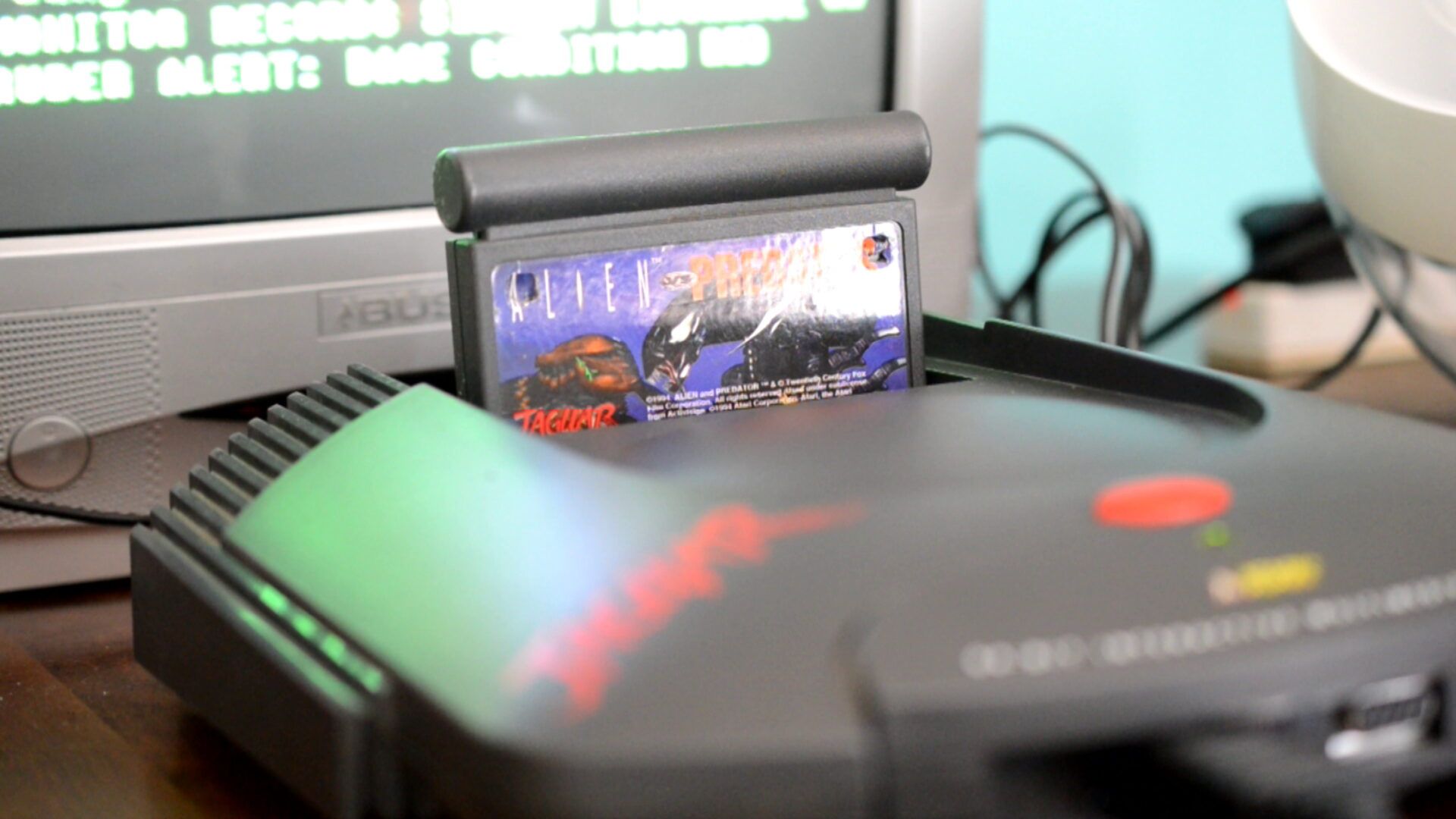
All their energy was now being refocused into their upcoming Jaguar console, but Lynx compatible features had been left dormant. The Jaguar includes a Com-Lynx line on it’s mainboard, a connector that was reported to allow communication between The Lynx and console, including rumours of using the handheld as a Motion Tracker for the upcoming Alien based game. An incredibly cool feature, that would have been ahead of systems like The Wii U, which at this point weren’t even in anyone wildest dreams.
The Lynx went from a product Atari were selling, to a product they were clearing.
This is obviously put in the 1993 letter to shareholders.
“In the third and fourth quarters of 1993, the Company wrote down inventories by $7.5 million and $10.6 million, respectively. These were write-offs of older 16-bit and below personal computers and 8-bit video game products and write-downs of Lynx and Falcon products to estimated realizable value, and were made concurrently with the introduction and change in marketing focus to the Company’s new Jaguar product line.” ~ Sam Tramiel 1993 Annual Report52
The focus was now firmly on the Atari Jaguar. In fact, the entire company was riding on the Atari Jaguar being successful, and we all know how that went.
By the end of 93 the company was fundamentally a smaller business. Offices had been closed in France, Germany, Spain, Italy, Sweden, Switzerland, Canada, Mexico, Japan, Australia and everything was condensed and downsized.
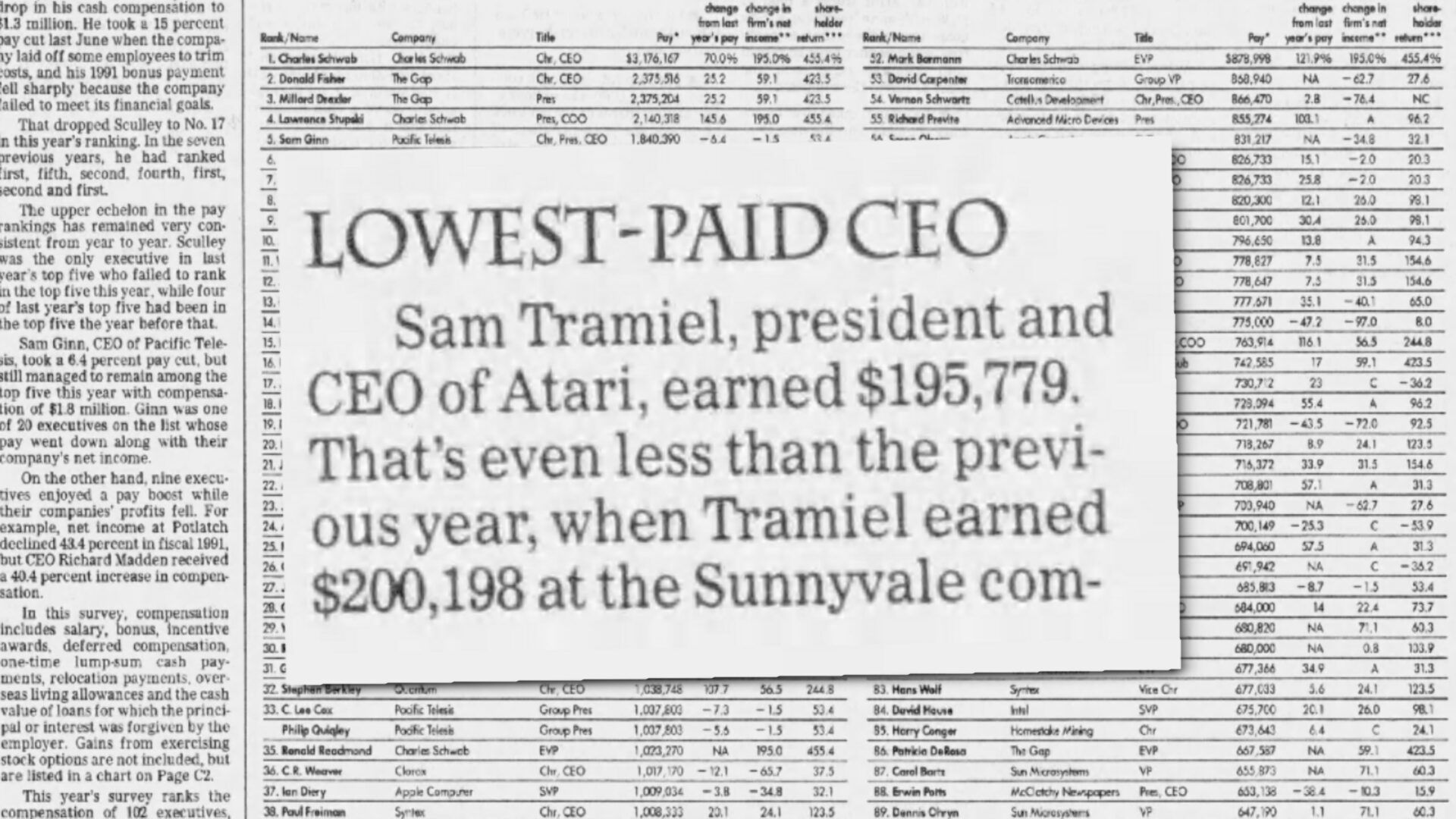
It’s not even like Sam Tramiel was taking all the money….
This was also the year that the remaining shell of Epyx was sold off to Bridgestone Media Group. Bringing a close to the console’s original home.53
Beyond
The final hurrah for The Lynx was The “Maximum” Pack. A console, bundled with four games that cleared out the remaining stock, whilst The Jaguar died in the background.
Still, we did get some releases. Let’s have a cheer and a moment for them. Because now, companies like Telegames were doing the publishing. Atari had very much taken a back seat.
Atari continued to try and raise finance despite tragic losses
“In order to insure the long term success of Jaguar, we need to raise capital. As part of this process, we sold an additional 1.5 million shares to Time Warner Inc. for a total of $12.8 million.” ~ That’s Sam in the 1993 annual report, laying it bare.54
By 1995 the Lynx is officially discontinued. The final published Atari games were Battlezone 2000 and Super Asteroids/Missile Command.55
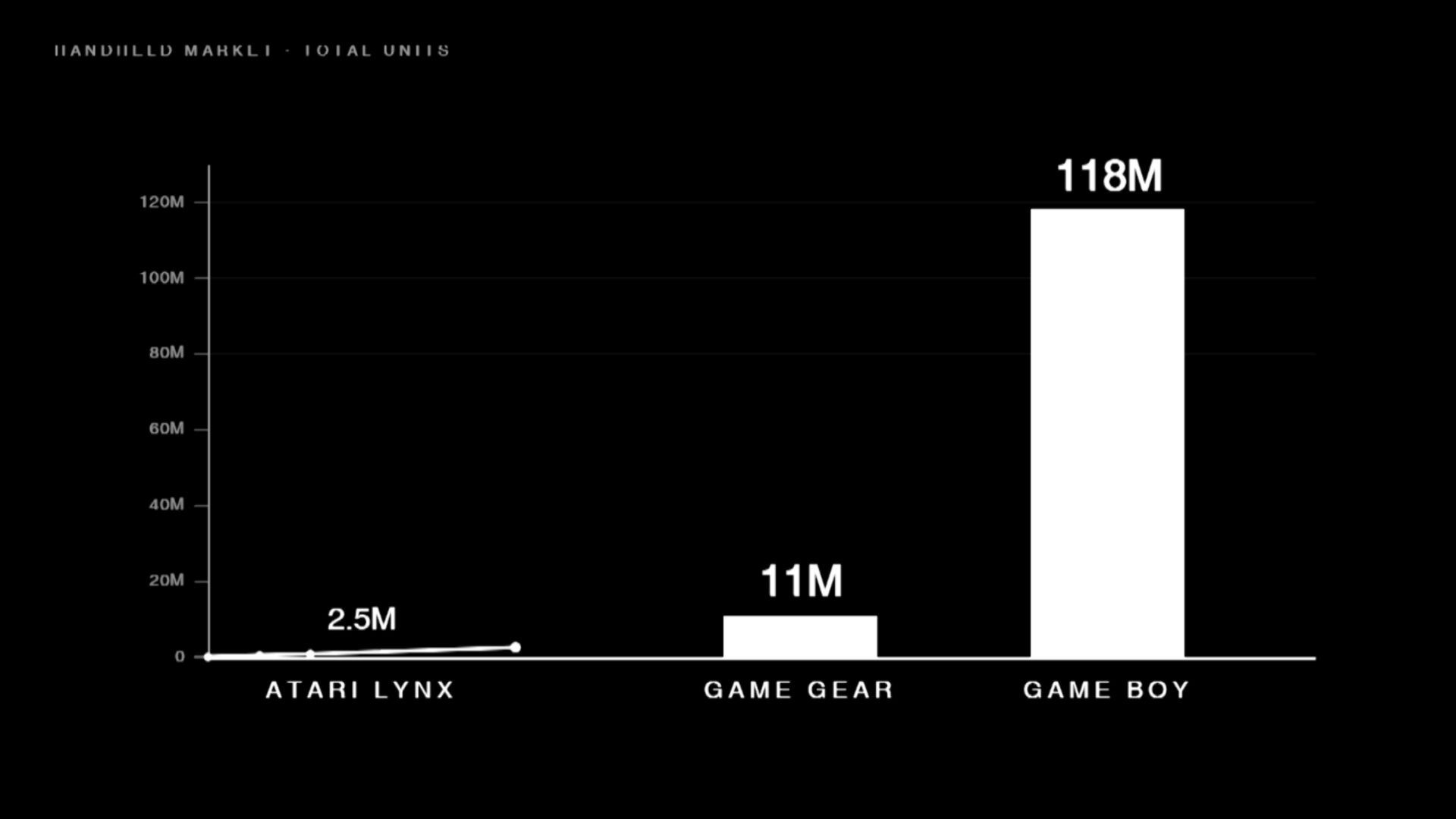
Lifetime sales are estimated to be between 2 and 3 million units. If you compare that to the Game Boy and even Game Gear, you can see the difference. We’re talking 2% of the Game Boy’s lifetime install base.
Game Boy lifetime sales make the other consoles look like a running joke
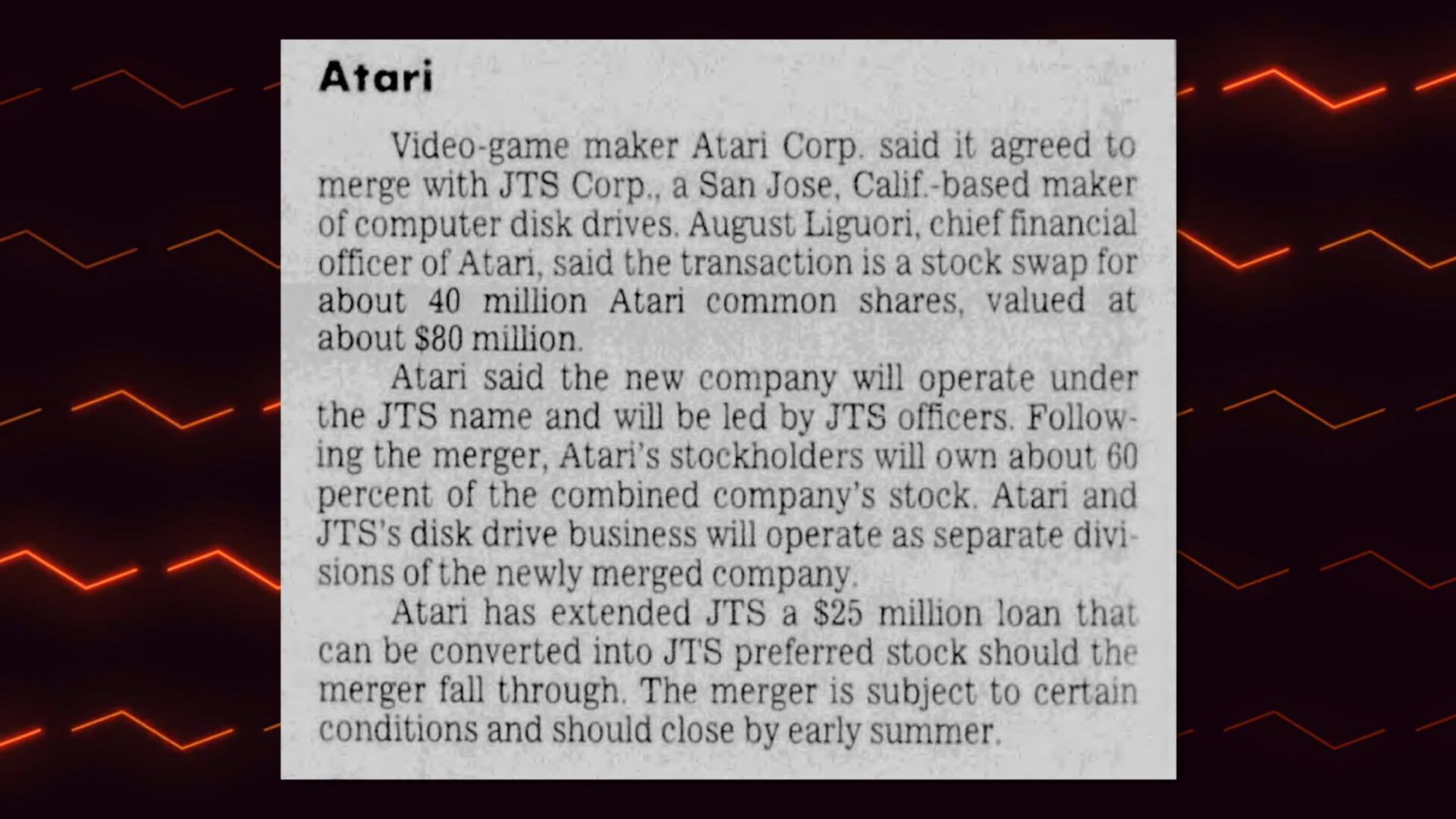
By 1996 Atari ceases all internal development and on the 30th July 1996 Atari merges JTS Corporation. Which it sold off in 1998 for $5million.56
JTS Corp, a manufacturer of hard drives, merged with Atari in 1996
Telegames being faithful to the core did continue to release titles.
In fact, they bought up most of Atari’s surplus stock and continued to run advertisements for games and refurbished Lynx systems at massively discounted prices.
But the dream was over.
What started as an incredibly powerful and impressive platform that should have made waves, ultimately didn’t. Atari’s missteps coupled with real world issues like battery life, cost and game selection meant that The Lynx couldn’t make it.
The amazing Xybots on a Lynx II
Nintendo wouldn’t even touch on the power the Lynx had until the Game Boy Advance came out in 2001. Over a decade later.
But for those of us who owned a Lynx, myself included. For those of us who got to experience the arcade feeling of Xybots back in 1991, we knew what we had.
Modern Day
Thankfully, like a lot of these under appreciated systems, today there’s a thriving homebrew scene, with a plethora of games, accessories and mods still being developed for this undernourished console. I’ve linked some key sites and threads below that are definitely worth looking at.
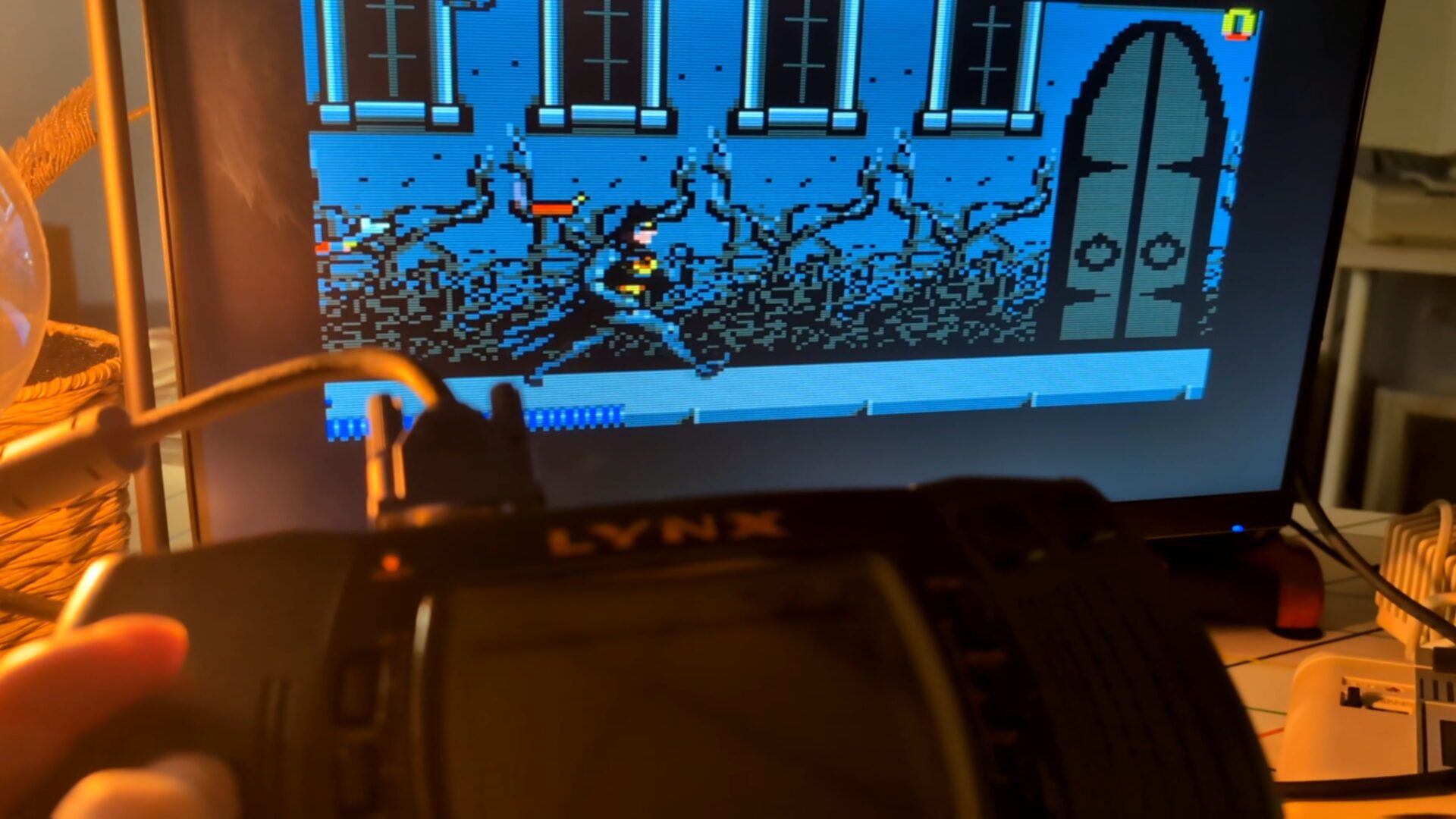
The Lynx II McWill Mod pushing Batman Returns into a VGA screen
This Lynx II for example has the Mcwill mod which improves the screen no end, and on this example integrates a VGA out. Very useful for making videos like this.
Talking of videos like this, they wouldn’t be possible without all the archivists, collectors and webmasters who have been uploading documentation, interviews, ROMs and forgotten content for years. These heros often go unspoken, but I’ve linked as much as I can below the video, and there’s a full text based version on my website that includes as many references and sources as possible.
These System Stories are a labour of research, collating, reviewing and love, but they do tend to wipe me out for a while afterwards. So as ever, thank you to everyone who supports my channel through Patreon, or just by clicking subscribe and the notification icon. Such a classic.
I’ll be back with another system story in due course. Until then please let me know if there’s any machine in particular you’d like to see in the comments, on my discord server, Bluesky or Instagram.
Apologies if I don’t respond to you in a timely fashion. It’s nothing personal. It’s just your basic internet overwhelm.
Until next time, I’ve been Nostalgia Nerd. Toodleoo.
If you are seeking specific sources that I had omitted/missed. Please comment below and I’ll do my best to add them!
Nostalgia Nerd is also known by the name Peter Leigh. They routinely make YouTube videos and then publish the scripts to those videos here. You can follow Nostalgia Nerd using the social links below.
Nintendo pitch per IEEE Spectrum’s tribute to Dave Needle and Wired’s account of Henk Rogers and Yamauchi; Needle, Morse and Joe Horowitz flew to Japan in 1988 [↩]
Winter CES 1989 private NDA demo per The Digital Antiquarian [↩]
Atari Corp vs Amiga, filed August 1984 – deal terms and lawsuit history reconstructed from court records by historian Marty Goldberg [↩]
David Sheff’s Game Over/Blake Harris’s Console Wars [↩]
Game Gear Japan launch October 6 1990 at ¥19,800, versus the Lynx at ¥29,800 per Famitsu issue 88; sales figures per contemporary Japanese trade reporting [↩]
Very standard and not at all suspicious cookies are used here to ensure you get the best experience. If you continue to use this site we will assume that you're a-ok with that.